Monthly Archives: March 2011
March Charcutepalooza: Corned Beef

My husband Howard and I have joined forces to participate in Charcutepalooza. This group, organized by Cathy Barrow and Kim Foster, will spend the year playing with meat as we explore Michael Ruhlman and Brian Polcyn’s book, Charcuterie: The Craft of Salting, Smoking, and Curing. This will be a joint effort. Howard will be “head meat guy” as we cure, brine, smoke, and otherwise preserve meat as the year passes by. I’ll be the sous chef, plus I’ll play scribe as I’m already blogging about what comes out of our kitchen.
Each month offers a new challenge. Experiences are summarized in a blog post on the 15th of the month. Duck prosciutto is one that can be done anytime this year. We missed the curing challenge in February, but we’ve joined up for March for brining as we corn a brisket for our annual St. Patrick’s Day dinner.
Having purchased a corned beef each March, sealed in its corning liquid and ready for a long cook with all the requisite vegetables, a home-corned beef is a revelation. There is no comparison. The process is quite easy. One of the biggest challenges was figuring out the right vessel for the brine process, one that was big enough for a 5-pound brisket, and would fit in the refrigerator. A 12-quart stockpot filled the bill. So, Howard prepared the brine, and the brisket spent five days submerged in the brine in the fridge. We like the Penzey’s pickling spice mix and are fortunate to live just one town away from an actual brick-and-mortar Penzey’s store.
Now comes the interesting part. For the past couple of years, Howard has been playing around with sous vide and LTLT (Low Temperature Long Time) cooking. Rather than several hours simmering on the stovetop, our corned beef was going to get the extra slow treatment. He had purchased a thermal immersion circulator on eBay and mounted it on plexiglass so it can sit over a large pot for cooking.

Thermal Immersion Circulator Rig
Howard vacuum-sealed the brined and rinsed corned beef into a FoodSaver bag. Based on timings recommended by Thomas Keller, he cooked the corned beef in the bag for 48 hours at 64C (147.2F). The gentle whir of the motor was background noise in the kitchen as it slowly cooked for two days.
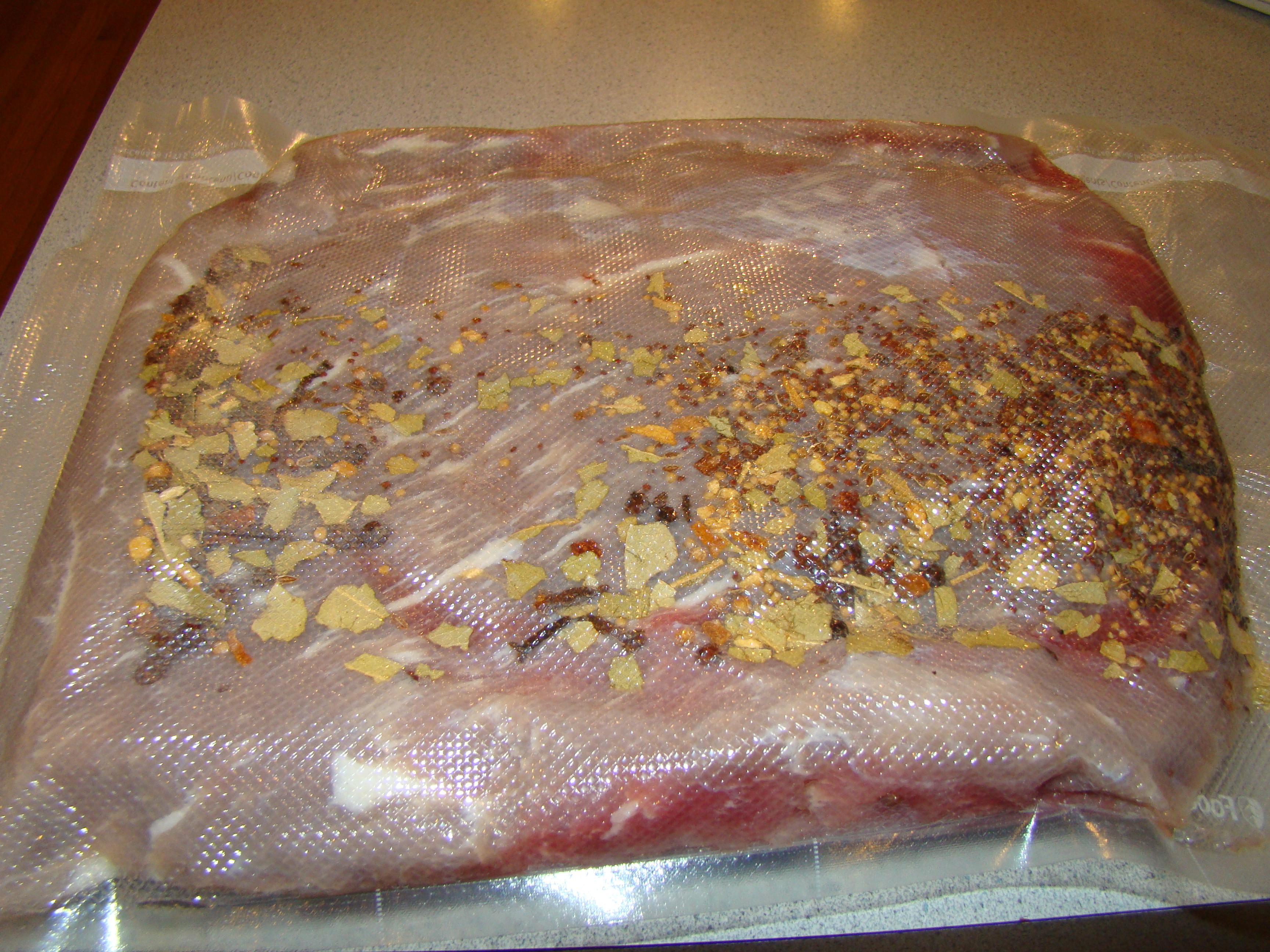
Brisket In A Bag
After two days, it was exciting to cut open the bag and see the results: a firm corned beef, still a lovely pink color, that smelled just like the pickling spices. The taste? It was slightly salty and tasted just like a corned beef should taste, only better. The firm meat sliced nicely for a beautiful presentation.
The corned beef was the centerpiece for an early St. Patrick’s Day feast. I’ve been tweaking the menu for years to capture the spirit of a New England Boiled Dinner, but with more interest and flavor. With the sous vide method of cooking the meat, the option of boiling the vegetables in flavored water is eliminated. That’s sort of OK with me because the boiled vegetables are my least favorite part of the meal. Even though I like the vegetables themselves, I find the end result of boiling to be bland.
This year, I tried something new by roasting the carrots, parsnips, and beets. Over the weekend, at both Whole Foods and Wilson Farm, a local farmstand, we sampled colcannon, which was the perfect way to include the requisite potatoes and cabbage in the meal.
Betsy and Howard’s St. Patrick’s Day Menu
Sous Vide Corned Beef
With Horseradish Sauce & Mustard
Colcannon
Roasted Carrots, Parsnips, and Beets
Duet of Irish Soda Bread
(Scallion and the more traditional Raisin/Caraway)
The corned beef came out so well that a second one is simmering in its water bath for Howard’s office’s holiday potluck on Thursday.
This charcuterie book has been part of our library since it came out in 2005, but the only meat experiments we’ve tried were bacon, pancetta, and corned beef, so we’re excited to go further. Can’t wait to see what’s in store for April, and we still have to make the duck prosciutto.
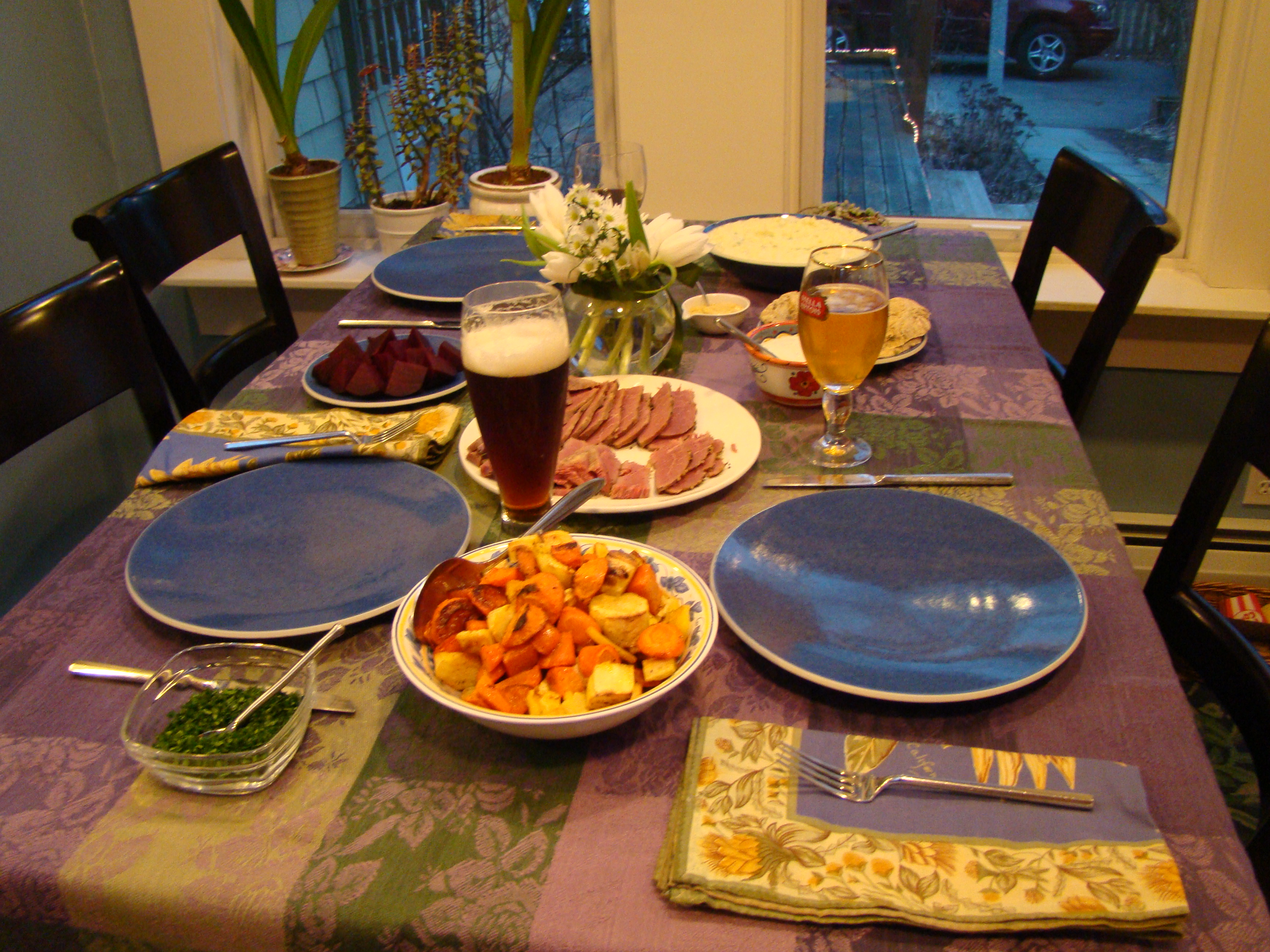
Here are the recipes for the Horseradish Sauce and the Colcannon that accompanied our corned beef dinner.
Colcannon
Serves 4
2 lbs potatoes (russet or Yukon Gold), peeled and cut into 2-inch chunks
½ small cabbage, cored and finely chopped, about 4 cups
2-3 scallions, sliced thin
¼ cup light cream
2 Tbsp butter
1 tsp salt, or to taste
Freshly ground pepper
Place the potatoes in a large pot. Cover with water and bring to a boil. Cook for 5 minutes. Add the cabbage and cook for 10 more minutes, or until potatoes are tender.
In the meantime, melt the butter in the cream. I did this in the microwave.
Place the sliced scallions in a colander, and drain the cooked potatoes and cabbage in the colander, wilting the scallions. Transfer all the vegetables to a large bowl or return to the pot. With a potato masher, mash the vegetables. Slowly add the cream and butter mixture to the vegetables, while stirring with a wooden spoon. Stir until incorporated. Add salt and pepper to taste.
Horseradish Sauce
½ cup plain yogurt
¼ cup sour cream
2 Tbsp grated horseradish
½ small onion, grated
Pinch cayenne
Fresh ground black pepper to taste
Whisk the yogurt and sour cream together until smooth. Stir in remaining ingredients. Taste for seasoning. Chill for at least 2 hours so flavors can mellow.
Restaurant Week Review: AKA Bistro (Again)
Last week and this week are Boston’s winter Restaurant Weeks. There will be another one in the summer. We always try to take advantage of the occasion to either revisit a favorite place or try somewhere new.
Last week, we revisited a new favorite, AKA Bistro, where we went for my birthday dinner in December. AKA Bistro has both a French and a Japanese menu. On our first visit, we both stuck to the French menu. The Restaurant Week menu featured items from both the French and Japanese menus, so Howard went with Japanese selections and I went with French.
Howard started his meal with Hokkigai (Surf Clam) Ceviche with tomato, orange and jalapeño. It was interesting. The clam was diced into small pieces and served in a citrusy broth. There was some clam in every bite. For his main course, he picked the Sashimi Platter. There were five different fishes, and each one offered its own innovative topping. There was salmon, fluke, branzino, yellowfin tuna and something else we can’t remember. It didn’t look like a huge portion, but turned out to be quite filling.
For my meal, I started with a salade de betteraves et fromage de chèvre frais (roasted beet salad with fresh goat cheese). I love beets to begin with. This salad was amazing. The beets were chopped coarsely with cornichons, mixed with vinaigrette and packed into a tuna-fish-can shape. I’m definitely going to have to try to recreate this at home. For my entrée, I had truite en persillade, pomme galette, citron et ratatouille (rainbow trout with pomme galette, lemon zest and ratatouille). Trout is one of my favorite kinds of fish, and we’ve been having a hard time finding it in the store for home-cooking. I tend to order it when I see it offered on a restaurant menu. The trout didn’t disappoint.
We both enjoyed our meals, and the tastes we had of each other’s, but I preferred the French.
For dessert, I ordered the crème brulee and Howard the chocolate mousse. It was funny. When the plates were served, they looked familiar. We had each ordered the same desserts when we were there for my birthday!
One thing I have to say about this restaurant, which is definitely a new favorite, is that they know how to serve tea properly. I am a tea drinker, but most restaurants do a very poor job of serving tea. I often don’t order anything to drink with dessert because of it. At AKA, you are served a pot of hot tea, freshly brewed from loose tea leaves. The pot is large enough for more than one cup, and it is very good quality tea. Kudos!
Later this week, we’ll be eating at L’Andana in Burlington.
 A Plateful of Happiness