Blog Archives
riviera fish soup {ffwd}

It was another cold, though less snowy, week here in the Great White North. I’ve noticed the days getting longer with the sun coming up earlier and setting later every day. I finally believe that spring might be coming, though I suspect we won’t see the earth under its multi-foot layer of snow until after spring’s arrival.
The idea of a pot of fish soup was a welcome antidote to the chill in the air. I could get excited about an imaginary dinner on the French Riviera. I made a grocery list and went to pick up what I needed. I was envisioning a fragrant tomato broth with other Provençal flavors like fennel, orange peel, and saffron. I was also anticipating spoonfuls of fish chunks surrounded by this lovely broth, but wait… The path to dinner was much different than I expected.
It started at the fish counter. Wegman’s has come to town (the next town, actually). I’m trying hard to like it and haven’t given up yet, but each visit I leave feeling like it fell short. Their produce is a nightmare, and their precut fish has been a disappointment because it always looks hacked into the pieces for sale.
One thing I’ll give Wegman’s props for is the display of fresh whole fish on ice at the fish counter which I don’t see everywhere. I was in search of a whole red snapper, so chose to shop there again. They didn’t have red snapper, so I opted for two ocean perch. The fish guy scaled them for me, and offered to fillet or whatever else I wanted to the fish, but I thought I was cooking them whole so declined.
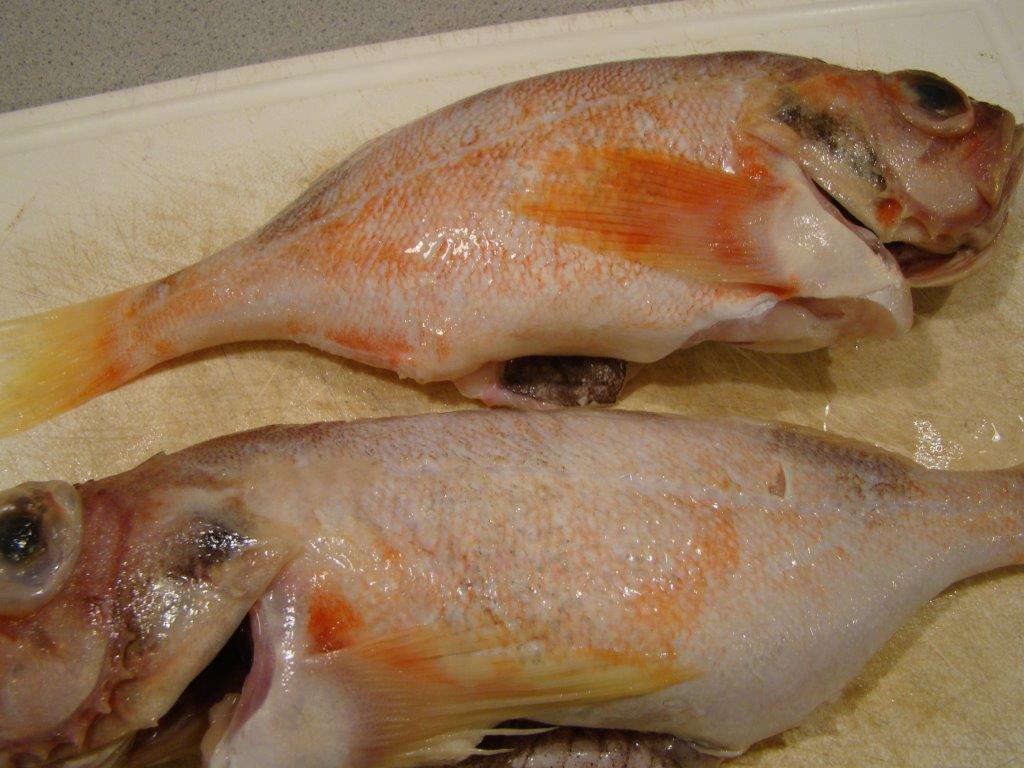
Ocean Perch — Aren’t they ugly?
At home, I finally read the recipe through. I realized that after I cut off the heads, the fish needed to be cut into chunks. I guess I could have had the fish guy bone the fish for me. Oh well. I googled what to do and did it myself. It didn’t seem like I was supposed to add the bones to this soup, so I froze them for fish stock another time.

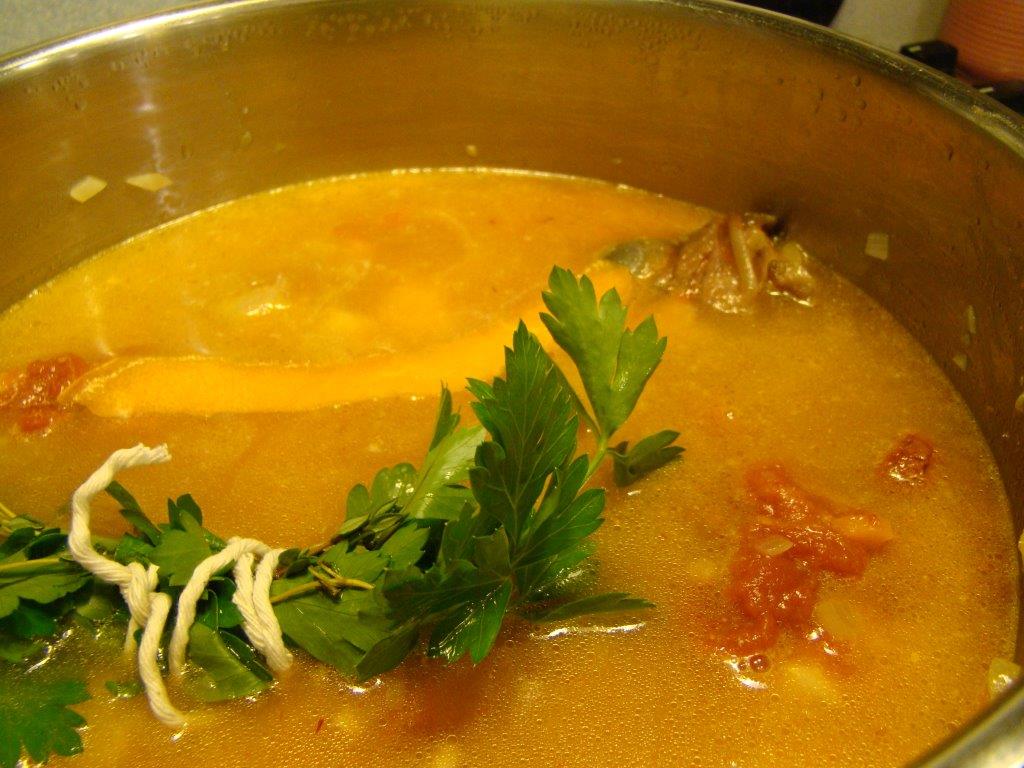
The remaining steps to make the soup were mostly easy and “the usual”. Vegetables are sautéed. The fish gets added. Liquid is supplied from chopped canned tomatoes and its juices plus water. Herbs, orange rind, saffron and Pernod (pastis, an anise liqueur) provide the seasonings as the soup simmers. The final surprise was the food mill. I was honestly confused by the concept of all of these ingredients being processed into a fishy puree. I did it, particularly because miscellaneous bones made their way into the pot, so this step made it easy to get rid of them, but it wasn’t what I expected.
I also had some issues making the rouille for topping toasts to accompany the fish soup. I make homemade mayonnaise a few times a year, starting with one whole egg, in my food processor. Because Dorie’s recipe uses just one yolk, I was worried that the volume would be too small for the food processor, so I used the blender. From experience, I knew it would splatter out the top, so I covered it with plastic wrap and poked a small hole in for drizzling the oil. I would swear I’d done this before, successfully, but this time, it didn’t work. My mayonnaise didn’t emulsify. I tried to fix it by slowly incorporating the failed mayo into a new egg yolk, but that didn’t work either. In the end, I dumped it and made a new batch using my old standby recipe which worked like a champ on the first try. As a nod to Dorie’s recipe, I used Dijon mustard instead of the dry mustard I usually use. (I’ve already made a few batches of croquants lately, so if anyone has suggestions for what to do with my egg whites, I’m looking for something new.)
In the end, I liked the flavors of the soup. Because of my original idea of what the soup would be like, the smooth texture threw me. I was OK with the broth having substance instead of being a clear broth, but I prefer fish chunks on my spoon instead of hiding in the soup. Upon rereading the recipe, I see that Dorie thinks the fine shreds of fish in each spoonful is more satisfying, for my taste, I disagree. If I make this again (which I might) I would cook everything except the fish chunks, puree that, and then cook the fish in the pureed soup.

Without a doubt, my favorite part was the toast with rouille on top. I could easily just eat the garnish without the soup. Fortunately, there’s still plenty left!
To see how the other Doristas fared in this last installment of “French Fridays” Fish Month, check out their links here. We don’t post the recipes for this group, but you can find it in Dorie Greenspan’s book Around My French Table.
arman’s caviar in aspic {ffwd}

Caviar is always a natural on New Year’s Eve, so I added this week’s French Fridays with Dorie recipe to our appetizer lineup for the night’s holiday dinner. I’d never had aspic, but I like both caviar and Jello, so as odd as this sounded, this had potential!
First, I made the aspic. I couldn’t find fish bouillon cubes anywhere. I had some clam stock concentrate in the fridge, but it was a bit old and I was reluctant to use it here, where the flavor could ruin a main component if it was off. However, given that I made several quarts of fish stock for last week’s simple Breton fish soup, I substituted fish stock for the water and just proceeded from there. I ended up with a loaf pan of thin but very sturdy aspic (or what I keep thinking of as fish jello). As I mentioned last week, the fish stock itself was thick and quivery, in other words, gelatinous, so I’m not sure whether this added to its firm structure.
To serve, I unmolded the aspic, cut it into squares, and, using a grapefruit spoon, carved out little dimples. I did this “right before serving”, as the recipe instructed, but I think I could have done this step an hour or so before serving and chilled until it was time to serve. I think I expected the aspic to be delicate and possibly to melt as it warmed to warm temperature, but it stayed firm even after sitting out for a while.
Finally, I spooned caviar into the divots and on top of the aspic squares and served.
For caviar, I used a jar of herring roe that we picked up at Ikea. They have quite an array of fishy products in the grocery section after you check out. We also bought some herring and a tube of salty fish roe paste. Yum to the fish paste (herring, not so much). I’m not sure this was the best choice. It was extremely salty and had a bit of an aftertaste. I think tobiko, which has similar tiny eggs, would have been a better choice, though I’m not sure where to find that other than the Japanese market. We also had salmon roe as part of another appetizer, and that caviar was much tastier, but I think the size of the eggs would have offered less contrast to the aspic.
Our guests and I thought it was good, a little strange, but not bad. I’m glad I tried it, but I’m not sure it was worth the effort. There are so many other ways I prefer to eat caviar.
To see what my Dorista friends thought of their caviar in aspic, check out their links here. You can find the recipe in Dorie Greenspan’s book Around My French Table.
Stay tuned for more fishiness next week!
 A Plateful of Happiness