Category Archives: Inspiration in Ink
Inspirations in Ink: The Soup Club Cookbook
 I love the serendipitous pleasure of coming across a cookbook that I’ve never heard of, one that grabs me and pulls me in. Such is the case with The Soup Club Cookbook by Courtney Allison, Tina Carr, Caroline Laskow, and Julie Peacock. From the cover depicting Weck canning jars filled with soup, to the explanation of what’s a Soup Club and how to start one, to the recipes inside, there so much to love about this book.
The authors, four friends and neighbors in New York City, formed a Soup Club, an ingenious idea where they each take turns making and delivering soup to the others. This idea allows them to share their love of food and cooking. For the cook of the week, it gives her the pleasure of sharing food from her own kitchen, and for the others, they can count on enjoying a home-cooked meal with minimal effort.
The authors lay out the basics for novices, like how to stock your pantry and how to make assorted homemade broths to serve as the foundation for the other recipes. Even an experienced cook will learn things. The tips on cooking large quantities of soup are helpful reminders as well.
In addition to recipes for simple vegetable, fish, beef, and chicken broths, you’ll find a variety of innovative soup toppers to try. At the top of my list are the Grilled Cheese Croutons and flavored Crème Fraîche.
Coming from four different home cooks with different backgrounds and tastes, the recipes cover a wide range of flavor profiles. The soups are grouped into sections based on the style of soup.
- The first group of recipes is for “Soups of Assembly” which start with broth and transform to a meal with the addition of other ingredients to create a “composed” soup, such as “faux” ramen and pho.
- Moving along to bean soups, you’ll find new (to me) variations on the standards of split pea (green or yellow), lentil, and black bean soups. I’m looking forward to trying the Spanish Chickpea and Spinach Soup.
- If you prefer smooth, pureed soups, the “Purees” section offer recipes using whatever vegetables happen to be in season. I’m glad it’s almost spring because the Roasted Asparagus Soup looks especially good.
- Hearty soups are chunkier. Recipes cover the agricultural cycle, from a creamless winter corn chowder to a summery zucchini soup with salsa flavors. The Senegalese Peanut Soup is the recipe that most intrigues me from this section.
- Summer seems a little closer when browsing the recipes for “Chilled” soups. For now, I’ll have to just imagine enjoying a refreshing bowl of Gazpacho (tomato, green, or watermelon).
- The book includes a handful of “Fish” soups, most notably a Thai Fish Curry.
- While most of the book leans towards vegetarian recipes, it is not a vegetarian cookbook. A section of “Meat” soups will satisfy the carnivores in your household with a bowl of comfort. The Filipino Healing Soup, with a full pound of ginger, is marked with a bookmark.
Each soup recipe includes suggested tips on how to package for delivery and finishing instructions for the recipient. Most of the recipes include accompanying garnishes to be added at serving time, and a few require some additions for ingredients that are best added at the last minute.
The spirit of the book wants you to share your soup, but the recipes can be reduced for single household quantities. I successfully quartered the Sun-Dried Tomato Soup, using oven-dried tomatoes and chopped basil that I’d stashed in the freezer over the summer.
As a bonus, the back half of the book gives recipes for soup accompaniments including salads and salad dressings, breads, snacks, side dishes, and even a few main dishes. As with the soup recipes, the collection of non-soup recipes make shareable quantities, so also lend themselves to casual party or potluck fare. All of the recipes are straightforward, yet interesting. In many cases, variations are suggested so you can make the recipe your own.
The different authors’ voices intertwine in the recipe headers and margin notes as the four friends talk about their recipes, their cooking strategies, and the Soup Club. Their commentary makes me want to be their friend, hanging out with them, eating, cooking, and just talking about food. In addition to the engaging text and appetizing photos, the hand-drawn illustrations made me smile.
I find the concept of the Soup Club to be appealing because I love to share the food I cook. At the moment, I can’t think of enough friends that would commit to participating. That doesn’t mean it couldn’t happen in the future. (Local friends, let me know if this is something you’d enjoy doing with me.)
If you already like soup or want to be motivated to make more of it, this book is for you. if you belong to a CSA with its steady supply of fresh seasonal vegetables, this book will help you answer the question of what to do with “all of that…” — you fill in the blank.
I can honestly say that, with exception of one recipe that contains shredded coconut (which I could omit), every recipe in the book appeals to me and is something I would possibly make for myself. I’ll let the seasons be my guide as I continue to sample the recipes in this book, using the freshest ingredients as their harvest time cycles by.
A Plateful of Happiness Rating: 4.5 plates (out of 5)
Disclosure: I received this book from Blogging for Books for this review. The opinions expressed are my own.
Inspiration in Ink: The Kitchn Cookbook
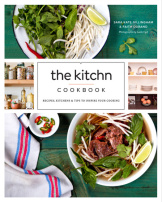 If you are a home cook, you can easily find a treasure trove of quality recipes and other cooking information on the internet. For some, it raises the question of whether cookbooks have outlived their usefulness. The question is doubly perplexing when authors of popular websites and blogs publish cookbooks that repurpose some of the material already available (for free) on-line.
As a bona fide cookbook addict who enjoys sitting unplugged to peruse the pages of a book, I haven’t bought into this general argument. Enjoying cookbooks doesn’t take away from my enjoyment of browsing websites, and The Kitchn website is top-notch with bountiful new content published daily. I am a faithful follower and can easily get absorbed in reading the posts for hours. So, I was curious to see how the authors (and editors of the website), Sara Kate GIllingham and Faith Durand, translated this long-running website to print in The Kitchn Cookbook, released in October 2014.
The Kitchn Cookbook would more aptly be named The Kitchn “guidebook” or “handbook”. While the book includes recipes, they cover less than half of its pages. Cooking is at the core of the book’s theme, motivating you to enjoy cooking at home. but it offers so much more.
The key message presented is encouragement to transform your kitchen into a place where you enjoy spending time and cooking. Creating a comfortable environment does not require an expensive renovation or remodeling job. It is presented as an achievable project for anyone, homeowner or renter, novice or experienced cook, by focusing on beauty and function in your kitchen.
The first part of the book provides practical ideas to help you set up your kitchen to enjoy spending time there and to put you in the mood to cook while you’re there. There is no one definition for a perfect kitchen. Your perfect kitchen is unique to you. In fact, what makes your kitchen perfect for you today tends to evolve over time, so the authors encourage you to embrace the continuous process.
Highlights from the first part of the book include a daily cleaning plan for a constantly clean kitchen, recommendations for environmentally friendly cleaning products along with some DIY recipes, and photo shoots in ten different home kitchens for inspiration.
The second part of the book shifts its focus to cooking. The same thread about personalization now extends from where you cook to what you cook. The book encourages you to cook wholesome homemade food as you define it at home more often.
Before jumping into recipes, there’s a chapter on stocking the pantry and planning meals. The properly stocked pantry depends on what you enjoy cooking, but guidelines are suggested with ideas of staples to keep on hand so you can cook spontaneously even when you don’t have much fresh food in the house. With all the potential landmines about which foods are nutritionally or politically correct to eat, I appreciated the reminder that, when making buying decisions, only you can prioritize and choose the compromises and tradeoffs that are right for you.
There is also chapter that presents a mini cooking school with 50 essential skills for cooking at home. Even an experienced cook can get a quick refresher course and maybe learn something new. For example, did you know you can caramelize onions in the slow cooker overnight?
Finally, the recipes start, not quite halfway through the book. About a hundred recipes are included. Some are reader favorites from the website, but there are some new ones as well. All seem accessible for any level of cooking expertise. I found many appealing flavor and ingredient combinations plus new techniques that I’m inspired to try. Top contenders for my “make this soon” list include (by section):
Morning
- Kale and Gruyere Breakfast Strata with Smoky Tomato Sauce
- Sweet Potato and Caramelized Onion Hash with Baked Eggs
Small Bites
- Roasted Chickpeas with Dukkah
- Three Tuscan Crostini
Drinks
- Pure Mexican Margaritas
- Sparkling Peach Sangria
Main Dishes
- Roasted Chicken Thighs and Squash over Polenta
- Slow Cooker Carnitas
- Baked Brown Rice, Lentils and Cauliflower with Cucumber Yogurt Sauce
Sides & Salads
- Fennel and Radicchio Salad with Farro and Pecans
- Roasted Brussels Sprouts, Cauliflower, and Radishes with Garlic Aioli
Desserts
- Meyer Lemon Bars
- Jam Hand Pies
The final chapter in the book, called “Gathering”, pulls everything together. Sharing meals is a form of sacred offering to people we care about. It’s something we should do often and not stress over. Becoming comfortable in your kitchen is the first step to enjoying yourself. The chapter shares advice for hosting worry-free gatherings and simple tips for decorating the table.
Taken as a whole, this book intends to boost the confidence of the home cook by always emphasizing that there is no right way to set up your kitchen, no right way to cook and no right foods to buy. It is all very personal. The book wants to help people feel comfortable cooking at home on a daily basis. This comes from setting up your kitchen, choosing kitchen tools, and stocking your pantry to work for you to cook what you like to cook. Even the most experienced cook can benefit from these reminders.
Now back to the question of book vs. website. This specific website has been on-line for nearly a decade. That’s a lot of content. I think the writing of this book provided an opportunity for the authors to compile, curate, and distill the best of the site’s material with the addition of new observations and reflections for a cohesive narrative that provides inspiration any time. Ideas and tips from readers and staff of the website are scattered throughout the book, bringing in voices from TheKitchn community to add to the authors’. As I mentioned before, I’m already a fan of TheKitchen website. After reading the book where their positive, encouraging philosophy is clearly spelled out, I now understand what has subconsciously kept me coming back for more.
A Plateful of Happiness Rating: 4 plates (out of 5)
Disclosure: I received this book from Blogging for Books for this review. The opinions expressed are my own.
 A Plateful of Happiness