Blog Archives
Cottage Cooking Club: November 2015

I’ve really fallen down on the job as a blogger. I cook daily, delicious things, but so often I neglect to take photos and then it’s all gone, or I take photos, but don’t sit down to write about my latest favorite dish. I’m promising myself to get back to a more regular schedule of posts in the new year, or before. In the meantime, my participation in the Cottage Cooking Club provides an occasion for sharing my thoughts on a few new recipes I tried this month.
If you don’t already know, the Cottage Cooking Club is an on-line group of bloggers who, under the leadership of the lovely Andrea, The Kitchen Lioness, has been cooking recipes from Hugh Fearnley-Whittingstall’s River Cottage Veg. Each month, Andrea selects one recipe from each chapter, each participant chooses the ones she wants to try, and at the end of the month, we share our experiences. I usually pick the ones are the most appealing to my palette. It’s great fun to read everyone else’s posts, and based on their reviews, add additional recipes to the never-ending list of ones to try.
Here are my thoughts on the recipes I chose, in the order I prepared them.

First up, I made the Roasted Potatoes with Two Mojo Sauces. I actually roasted potatoes on two separate occasions and each time served the potatoes with a different mojo sauce. Roasting potatoes is a straightforward thing, but these instructions resulted in a crispier exterior than I usually get, so I was delighted to have a new trick up my sleeve. I made a half batch of each sauce because I could tell each made a large quantity. We enjoyed both the red and the green sauce which had a (American) Southwest flavor profile – a bit surprising from a British cookbook. The sauces went well with the potatoes and also on top of simply roasted chicken. (Can I say that when this book is supposed to be about the vegetables?) This was my favorite of this month’s recipes.
Next, I made the Kale Speltotto, though it would be more accurate to say I made Kale Farrotto. This recipe is similar to risotto, using spelt (or in my case, farro) instead of Arborio rice. Hot broth is gradually added to the grain, letting it absorb completely between batches. I made a squash stock from seeds I’d scooped from a winter squash earlier in the week.
As for the grain, I had whole-grain spelt in the pantry, but was worried that, because it wasn’t pearled, it wouldn’t cook in time for dinner. I couldn’t find any pearled spelt at the store. After reading the package of the brand of farro I had at home, it seemed like its cooking time would work. Of course, when I got home, I found that I didn’t have nearly enough farro OR pearl barley on-hand. I did have plenty of parboiled farro, which typically cooks up in 10 minutes. I wasn’t sure how it would work out, but it was a success. It took longer than 10 minutes to cook, but was done when pearled spelt would have been. I used kale I had picked myself after a volunteer shift at the farm.

The combination of kale and leek was delicious. I was also out of goat cheese (normally a staple), so I topped this with grated Parmesan.
Lesson learned: Take a better inventory of what you have before deciding what to make for dinner, though if you misjudge, it almost always works out with whatever you have.
The final recipe I prepared from this month’s choices was the Beet and Walnut Hummus. I love beets. Beet-Walnut Salad is one of my favorite ways to eat roasted beets. This dip had similar ingredients, but the final result wasn’t a favorite. The beets overpowered all the other flavors except the cumin. And it was extremely sweet – too sweet for our taste buds. The sesame flavor of the tahini didn’t stand out at all. We prefer either the creamy texture of hummus made with chickpeas or the chunkier texture of my usual beet salad.

In addition, I finally made the Twice-Baked Potatoes the group made last November. They were fabulous. My mother used to make a simpler version of this, simply scooping out the potatoes, mashing the innards, refilling the potato shells, and generously sprinkling the top with paprika before rebaking. Hugh’s version is much more decadent. The filling is like a loaded baked potato, mixed with sour cream and cheddar cheese and studded with scallions. This is a vegetarian cookbook, but crumbled bacon would be at home in the filling. These are a new favorite, and they were perfect to serve to company!
Our Thanksgiving table wouldn’t be complete without roasted Brussels sprouts. One of my favorite ways to prepare them is Hugh’s Roasted Brussels Sprouts with Shallots. Since the group first made this last October, I frequently revisit this recipe, and I baked a batch to bring to the Thanksgiving feast we attended with friends.
I hope all of my American Cottage Cooking Club friends had a wonderful Thanksgiving holiday, sharing good food and company with family and friends. I look forward to catching up with all of you again in December.
To find out what the other Cottage Cooking Club bloggers thought of their selections this month, follow their links here.
Cheers! (P.S. WordPress tells me this is my 500th post! Hard to believe…)
Cottage Cooking Club: June 2015
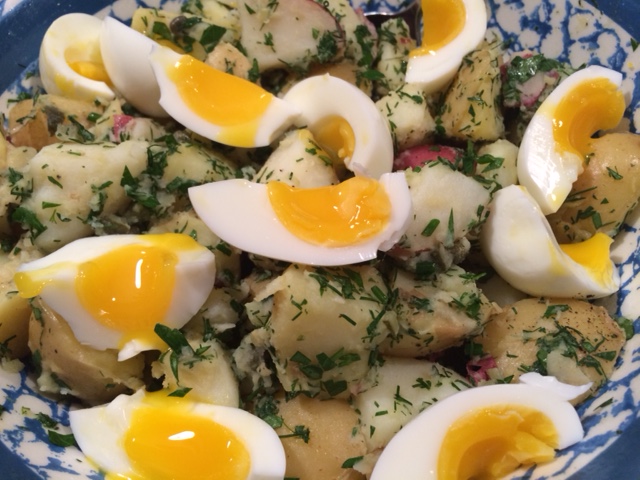
Finally after a long, long winter, fresh local vegetables are starting to be plentiful around these parts. Mostly what we’re seeing is Greens, Greens, and more Greens, though spring roots like radishes and salad turnips are being harvested too. I tried to align what’s available with the recipes I picked from Kitchen Lioness Andrea’s lineup for Cottage Cooking Club this month. The recipes we cook from British chef Hugh Fearnley-Whittingstall’s cookbook, River Cottage Veg celebrate vegetables, sometimes in familiar ways, and often with an unfamiliar twist, which has been fun.
I chose two recipes this month. The first was New Potato Salad “Tartare”. I love potato salad, especially ones made in the French style with a vinaigrette. My signature salad is a Dijon potato salad (which I’m shocked to find I’ve never blogged about), but I’m always up for trying a new version. The flavorings in the salad were inspired by tartar sauce, without the mayo. What a refreshing twist! Chopped cornichons, capers, and fresh herbs (dill, chives, and parsley) are added to potatoes along with a simple vinaigrette. Quartered “soft” hard-boiled eggs add the final touch. I was even able to use chives and parsley from my back door herb garden!
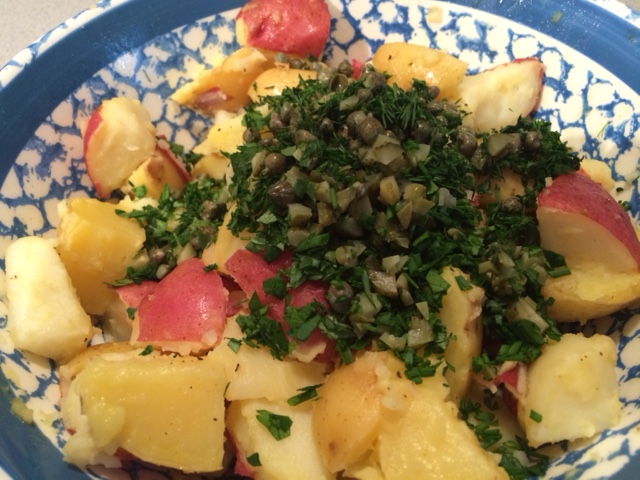
The only thing I’d change about this is the cooking method for the potatoes. Whenever I boil potatoes for potato salad, I’m unhappy. The potatoes always seem water-logged. I have much better luck with steaming them. I followed the recipe and tried boiling them as directed, but I should learn by now to stick to my preferred method.
Other than this hiccup, I loved the end result. The contrast of the salty tangy pickles to the fresh verdant flavor of the herbs make a winning combination. I’ll definitely be making the River Cottage version of potato salad again this summer!
The second recipe was the Greens and Ricotta Tart. I couldn’t find beets with greens the day I went to the farmers market (just a tad too early in the season), but I found beautiful Swiss chard from Kimball’s Farm. I also couldn’t find ricotta salata where I looked, so I substituted another sheep’s milk cheese: Spanish Manchego. Savory tarts are another favorite of mine. In the summer, I make one almost every week. Again, I’m always happy to try a new combination and learn something new.

I love when a recipe that uses both the stems and the leaves of greens. It always feels wasteful to discard the stems which they are perfectly edible, though not always in the recipe at hand, and try to do “nose-to-tail” cooking of vegetables when possible. For this tart, thinly sliced stems are sautéed with the onion and garlic before adding the leaves to wilt. The custard for this tart is made richer with egg yolks and cream.
The pastry crust was interesting in its use of cold milk instead of water. I found the dough to be easy to work with and the final pastry had a flaky texture. The crust didn’t brown as I would have expected, but I’ll admit I’ve been having some issues with my oven temperature and it was probably that, not the recipe.
My intuition told me to use a larger tart pan than called for, so I chose an 11-inch instead of a 9-inch. This was the right call. The crust fit into the larger pan with no trouble, and I had custard leftover. I ended up making a mini-crustless tart with some already cooked broccoli rabe and the extra custard.
I was very lucky in my choices this month: two winners that I will definitely make again this season.
One of my favorite parts of this group is seeing the other participants’ results with the recipes I didn’t choose to make. It helps me narrow down the other winners in the book that I must try. If you’d like to see their posts, you can see them here.
 A Plateful of Happiness