Blog Archives
scallop and onion tartes fines {ffwd}
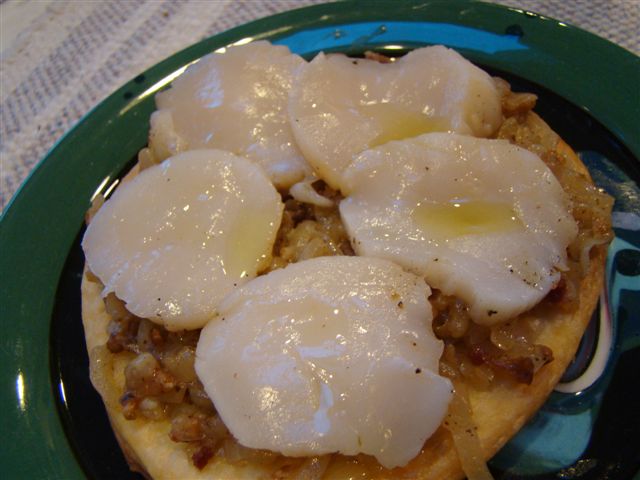
This week’s recipe for French Fridays with Dorie is an elegant and substantial starter. Disks of puff pastry are topped with a mixture of caramelized onions and bacon, then adorned with barely cooked sea scallops.
Let’s start with the puff pastry. For whatever reason, I always have the hardest time rolling out thawed puff pastry. The thawed slab never seems to get much bigger. That means that every time I’m faced with a recipe that calls for puff pastry, I get a pit of dread in my stomach.
Last month, I came across a recipe for Quick and Easy Puff Pastry on Chocolate & Zucchini. I’ve been looking for an opportunity to try it out since then. Clotllde said this recipe changed her life. Now that I’ve made it myself, I can see why. It was truly easy. The technique wasn’t the laminated style of a true puff pastry, where the butter is rolled into a slab that gets rolled inside the pastry dough. This is more of a rough puff pastry where butter is cut into the flour, staying in relatively large pieces. After that, the fold and roll steps to form layers is similar.
No food processor required either. This is a purely manual operation. I cut the butter in with a pastry blender. Then ice water is incorporated with a dough scraper. Finally, a few roll and fold repetitions, one full rotation and then some (I lost count, so did some extras), and that’s all that was needed. I splurged on Plugra, though I’ll have to make it again with my usual butter to compare. The dough remained supple and was very easy to roll out, but in the making, and later when I rolled out for the disks. I’m thinking I’ll never buy puff pastry again.

My favorite part of this recipe was the onion and bacon mixture. I sliced my onions thin, though you can also choose to chop them finely. My new trick when caramelizing onions is to cover the pan for the first 10 minutes or so to accelerate the softening of the onions. Then, the uncovered onions continue to cook, and brown, and finally caramelize. This combo would be great to fill a full-sized savory tart too.

Finally, the scallops. I’ve never seen them as expensive as they were this week. I nearly fell over when I saw them priced at $28.99 a pound. I was only making half the recipe, so I asked for three scallops (they were huge), which ended up weighing just under half a pound for $11. Even though I trust the freshness of Whole Foods seafood counter, I seldom keep uncooked fish in my refrigerator overnight. I’m a “eat it the same day I buy it” seafood shopper. I mixed up some dates this week, so ended up buying the scallops two days before I actually needed them. This made me squeamish about eating them raw (OK, barely cooked). Instead, I seared the scallops the way we have before, then sliced them into disks to top the mini-onion tarts.
The final word? We both liked them. We agreed that the onion and bacon topping was so satisfying that we would have liked them just as well without the scallops. Also, Clotilde’s rough puff pastry is a keeper. It tasted fantastic! Even with the expensive European butter, it is still more economical commercial puff pastry. And no dread involved.
To see how my Dorista friends’ tartes came out, check their links here. We don’t post the recipes, but you can find it in Dorie Greenspan’s book Around My French Table.
recipe swap onion “carbonara” {ffwd}
Many moons ago, I worked for a software company called ITP, which was the child of a company with the same name located in Italy. In Italy, the name was short for “Informatica e Tecnologia per la Produzione”. In English, ITP didn’t stand for anything, though we joked that it stood for “Italian Technical People”. One year, a few guys from the Italian office came stateside to work with the team. The company was populated by young technical professionals (computer geeks), and we were very social. We shared meals together, went out for drinks together, and played highly competitive games together (Killer versions of Uno and Pictionary). We integrated the Italians into our fold.
Lucio and Guido were excellent cooks and enjoyed sharing “real” Italian food with us. It was from them that I learned about spaghetti carbonara. What’s not to like about bacon and eggs and cheese. It was also easy to whip up for a crowd. Saute the bacon while the pasta cooks, then toss with scrambled eggs that get cooked by the residual heat of the pasta. Add a healthy dose of Parmesan cheese and, voila (or the Italian equivalent): you have a meal.
For some reason, nowadays, spaghetti carbonara has fallen out of my repertoire. This week’s French Fridays with Dorie recipe, Onion Carbonara, reminded me of what I’ve been missing. The recipe originally came from Michel Richard, a pioneer in molecular gastronomy, by way of Patricia Wells’ table. He redefines the term “playing with your food”. Years ago, Howard and I watched a fascinating video where Michel Richard reinterpreted classic dishes in ways that amused the chef and surprised the eater. We liked it so much, we watched it multiple times. (I searched the Internet high and low, but could not find a link. It might have come from the now-defunct Gourmet magazine’s foray into videos shortly before its demise.)
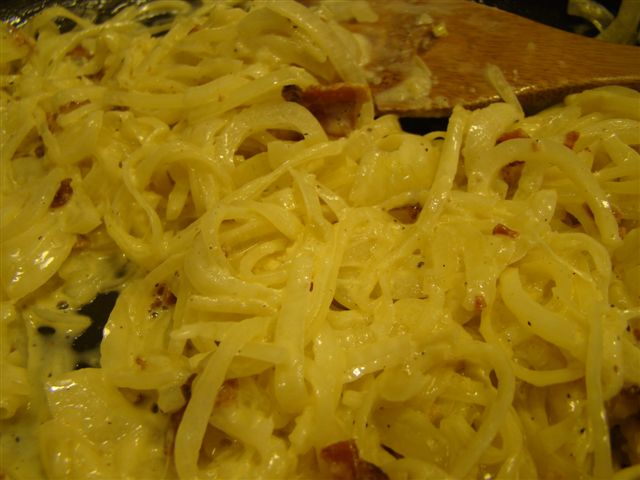
In this incarnation of carbonara, no pasta is involved. Steamed strands of onion stand in for the pasta, though the sauce is classic. Onion carbonara is simple to make. As I said, you steam the sliced onions. And you fry some bacon. After that, the sauce takes just minutes to complete. Melted butter is mixed with the bacon and cream. The onions (aka faux pasta) are warmed in this sauce. Add more cream and an egg yolk and toss to cook the egg. Finally, add some Parmesan cheese and it’s ready to serve.
The final result was definitely interesting and completely edible. However, I prefer the classic pasta version (or my memory of it) and plan to add it back into my kitchen lineup in the new year. To try the low-carb, no pasta, onion version, you can find the recipe here. Or, you can always find it in Dorie Greenspan’s book Around My French Table. To see how the Doristas did with this one, follow their links here.
 A Plateful of Happiness