Blog Archives
Dorista Holiday Recipe Exchange {ffwd}

Happy Holidays!!!! As part of this year’s holiday card exchange for French Fridays with Dorie, participants optionally included a recipe for a favorite holiday cookie, cocktail or other confection. In addition to the lovely exchange with our faraway friends, this week’s challenge is to try out any of the recipes that arrived in the mail.
There were so many delicious choices, but I decide to try the Cracker Candy from Karen of Our Crazy Blessed Life and the Apple Cider Sidecar from Guyla of Clementines and Cocktails.
Karen’s Cracker Candy is a treat is a chocolate coated toffee confection. Her mother gave her the recipe 17 years ago, but it originally came from her grandmother. I’ve enjoyed this many times before when other people have made it, but I’ve never made it myself. I’m not sure why because it is so simple. Butter and brown sugar are boiled together to make the toffee, which gets spread over the surprising base of saltine crackers and popped in the oven to make sure it saturates the crackers. Then, a bag of chocolate chips is scattered over top where the residual heat melts it. You spread the chocolate to cover the toffee. Karen’s recipe invites some tinkering on top of the chocolate, so I sprinkled a cup of finely chopped almonds on top. Once everything cools and hardens, you have an irresistible (at least to me) nibble.
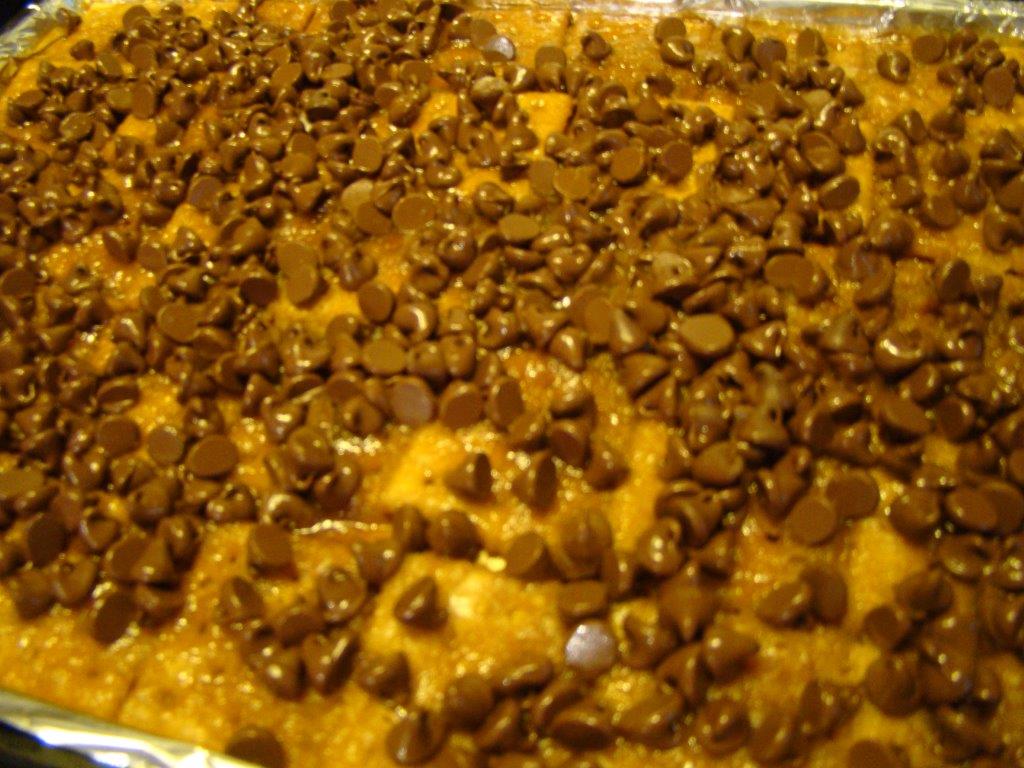
Karen’s Cracker Candy
40 saltines
1½ cups butter
1½ cups brown sugar
1 12 oz package chocolate chips
Preheat the oven to 400F. Place saltines side by side on a foil-covered cookie sheet.
Bring the brown sugar and butter to a boil. Very important: boil for 3 minutes. Spread the mixture over crackers. Bake for 5 minutes.
Sprinkle chocolate chips over the baked crackers. Let stand 5 minutes. Spread chocolate evenly.
At this point, you can have some fun and sprinkle a topping like crushed peppermint, toffee bits, or sprinkles.
Refrigerate until solid. Remove foil and crack into pieces. Keep refrigerated.
I also couldn’t resist Guyla’s festive cocktail, the Apple Cider Sidecar. It was a breeze to mix together. The fresh lemon juice and the Cointreau infused the drink with citrus flavors, tasting like a cold cup of spiked mulled cider. Cheers, Guyla!

Apple Cider Sidecar
Makes 4 cocktails
10 oz best quality apple cider
4 oz brandy
5 oz Harlequin or Cointreau
2 oz freshly squeezed lemon juice
Stir together all ingredients and shake over ice. Pour into cocktail glasses that have been rimmed with raw sugar.
As my final French Fridays post of the year, I wanted to share a remembrance of all the meetups I had with my Dorista friends in 2014. Though unphotographed, I also saw Dorie Greenspan at her book signing at the Harvard Book Store in November.
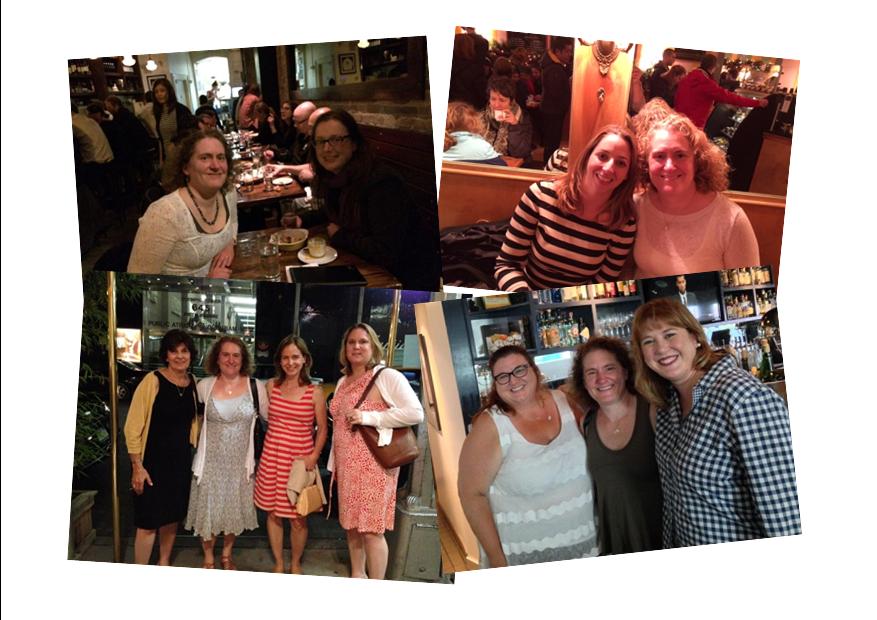
Clockwise starting from left corner: I shared dinner with Mardi of eat. live. travel. write. when she visited Boston in March, Thanksgiving weekend, I spent the afternoon with Adriana of Great Food 360. I met Susan of Create Amazing Meals and Christy of Confessions of a Culinary Diva for lunch during my Southern California vacation with Howard in June, In July, I spent the weekend in New York City with Kathy of Bakeaway with Me, Diane of Simple Living and Eating, and Cher of The not so exciting adventures of a dabbler.
I am so happy about these friendships that started over food shared over the internet and have forged over meals shared in person.
To see other Dorista creations for this week, check other links here.
dilled gravlax with mustard sauce {ffwd}

Howard is a master of gravlax. For many years, it’s been his signature appetizer for special parties. With French Fridays with Dorie’s gravlax on the schedule, we decided it was time for a throwdown challenge. I’ll admit to not doing any of the cooking. I was in charge of the shopping for this one. It’s not that I had anything against the recipe, but wanted an equally experienced touch for a better comparison of the two recipes.
I bought a large side of salmon, about 3½ pounds. We cut it in half crosswise and Howard made each half with a different recipe. The basic process for gravlax is to coat the fish with herbs and a sugar/salt curing mixture and leave it, pressed under weight (i.e. cans), in the refrigerator for 2-3 days. During its cold rest, the rub draws moisture out of the fish, curing (cold cooking) it.
The first difference between the two recipes is the flavoring. Dorie adds black and white peppercorns plus coriander seeds to the rub. Howard only adds white peppercorns to his dry mixture, though he rubs the fish with some aromatic liquor first. This time he used Pernod, but aquavit is good too. The main difference is the proportions of sugar and salt in the curing mixture and the total amount of dry rub used. Dorie uses a 3:1 ratio (yes, I’m a math geek) of salt to sugar, and the total amount of rub is just a few tablespoons. Howard uses the opposite: a 2:1 ratio of sugar to salt, and the total amount is a little over two cups.
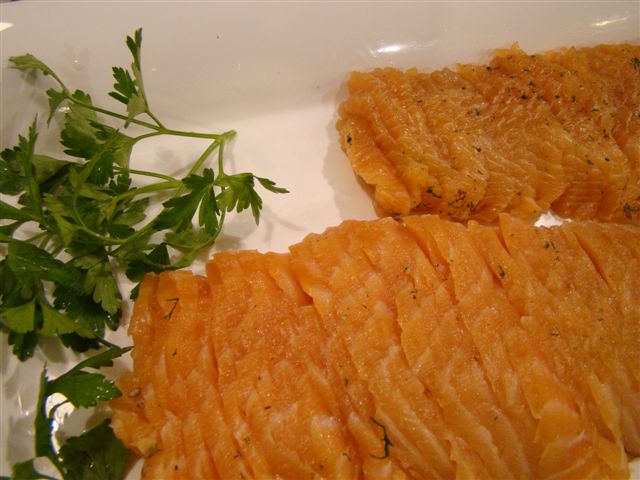
Gravlax Throwdown:
Dorie’s in upper right, Howard’s on bottom
As I said, this is Howard’s signature appetizer for special parties, and we had the perfect occasion. Every year, we celebrate Christmas Eve with longtime friends who make the traditional celebratory Feast of Seven Fishes. All the guests bring contribute dishes to for the meal. This year, the game plan was to start with an abundant appetizer extravaganza accompanied by a festive punch and other drinks. We brought both styles of gravlax for a broad tasting. (I made mini-crab cakes.) Later in the evening, we sat at the table to enjoy a delicious Niçoise salad, followed by bourride, a French fish stew heavily laced with aioli. Dessert is an array of home-baked cookies, just the right size to fit into any empty parts of your belly. As always, it was a fantastic meal, one we look forward to all year!

Mini-Crabcakes, ready to be baked at the party
The two styles of gravlax had similar texture and were both delicious. Howard’s “original” version gave off considerably more liquid during the curing process and was firmer than the one prepared Dorie’s way. Dorie’s version was also a little harder to slice thin, probably because it wasn’t quite as firm. We brought half of each half to the party, and there was very little leftover. Both were quite popular with everyone. We’ve been enjoying the salmon we kept for ourselves on bagels with cream cheese in the mornings for the past few days. What a treat!
So, what’s the verdict? I’d say that if we’d never made gravlax before, this recipe would become a standard in our repertoire. However, it isn’t different enough than Howard’s usual recipe, so that recipe won’t get displaced. The recipe is definitely a good one, so I urge you to try it if you’ve never made gravlax before.
Dorie gives a recipe for a dilly mustard sauce to accompany the fish (which I forgot to take a picture of). We didn’t do a side-by-side comparison of her sauce to our usual. Dorie’s was similar and equally delicious. Her recipe uses using much less oil that the other, so it’s healthier. While the gravlax recipe wasn’t different enough to mandate a switch in the future, her sauce is a new keeper.
You can find the recipe for both the gravlax and the sauce in Dorie Greenspan’s book Around My French Table. It’s also on-line at Epicurious. You can also read about other Dorista bloggers’ gravlax by following their links here.
In case this is my last post of the year (though that isn’t my plan), I wish you all a Happy New Year! May the year ahead be filled with love and laughter, and of course, good food! I’m looking forward to sharing many more kitchen adventures in 2014.
 A Plateful of Happiness