Blog Archives
chicken in a pot: the lemon and garlic version (the final recipe) {ffwd}

How did we get here? In October 2010, I joined a new cooking group, French Fridays with Dorie, a group taking up the challenge of cooking their way through Dorie Greenspan’s book Around My French Table. Each week, each member of the group cooked the same recipe and wrote about it on their blog on Friday. Week by week by week, here we are over four and a half years later cooking and sharing our last recipe from the book. We saved the cover recipe, Chicken in a Pot (the Lemon and Garlic version) to mark the milestone.
Looking at the cover photo week after week, year after year, the whole chicken with its burnished skin lying on a bed of vegetables, I always assumed chicken in the pot was a variation on roast chicken. Appearances can be deceiving. On reading the recipe, it turns out this is actually more of a braise. Either way it was delicious.
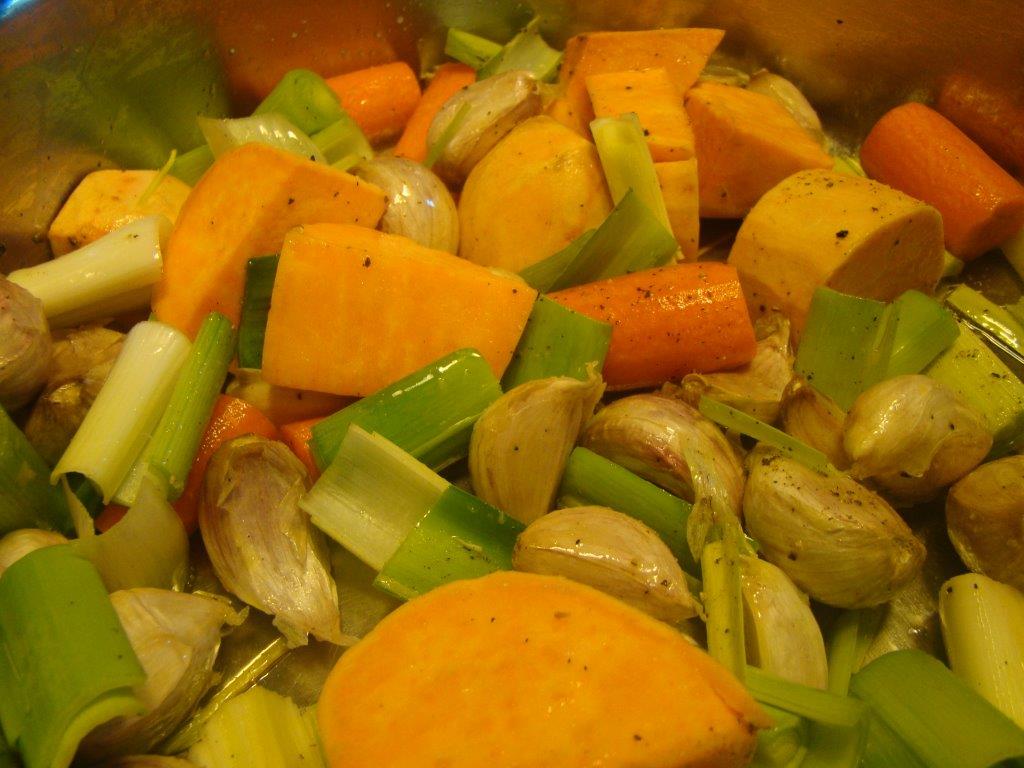
And easy! First, you brown the vegetables. Sweet potatoes, carrots, celery, onions, and FOUR HEADS OF UNPEELED GARLIC broken into cloves! I thought I had baby onions in the freezer, leftover from the Marengo, but I couldn’t find them. I did find two leeks in the refrigerator, so I halved them lengthwise and cut them into 1-inch pieces to stand in for the onions. The vegetables are transferred to a Dutch oven along with sprigs of herbs and some diced preserved lemon. (Did you know that Trader Joe’s now sells sliced preserved lemon in a jar?)

Then, you brown the chicken. I had thawed a whole chicken from the freezer in anticipation of making this version of a “roast” chicken, but when I realized my error, I ended up cutting it into pieces before browning. Much easier to manage on the stove and then the plate. (And there’s the added bonus of sautéed giblets for the dog.) The chicken pieces are nestled on top of the bed of vegetables.
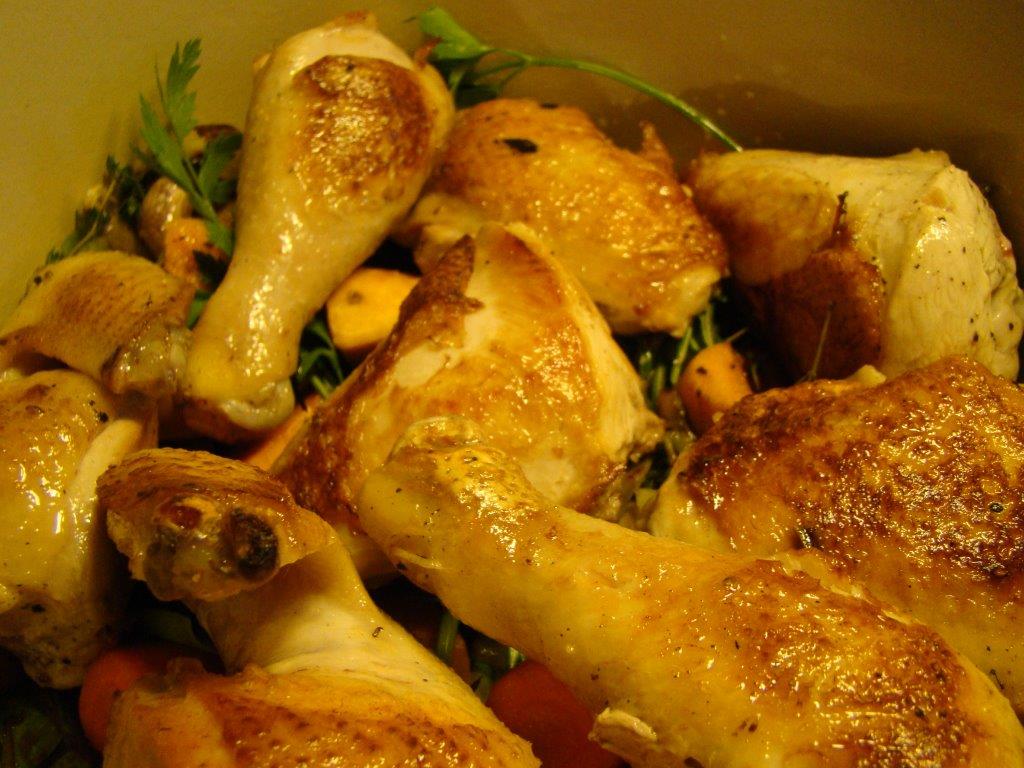
A bit of liquid is poured over the top. I was out of chicken stock, so just used water instead, plus some white wine and olive oil.
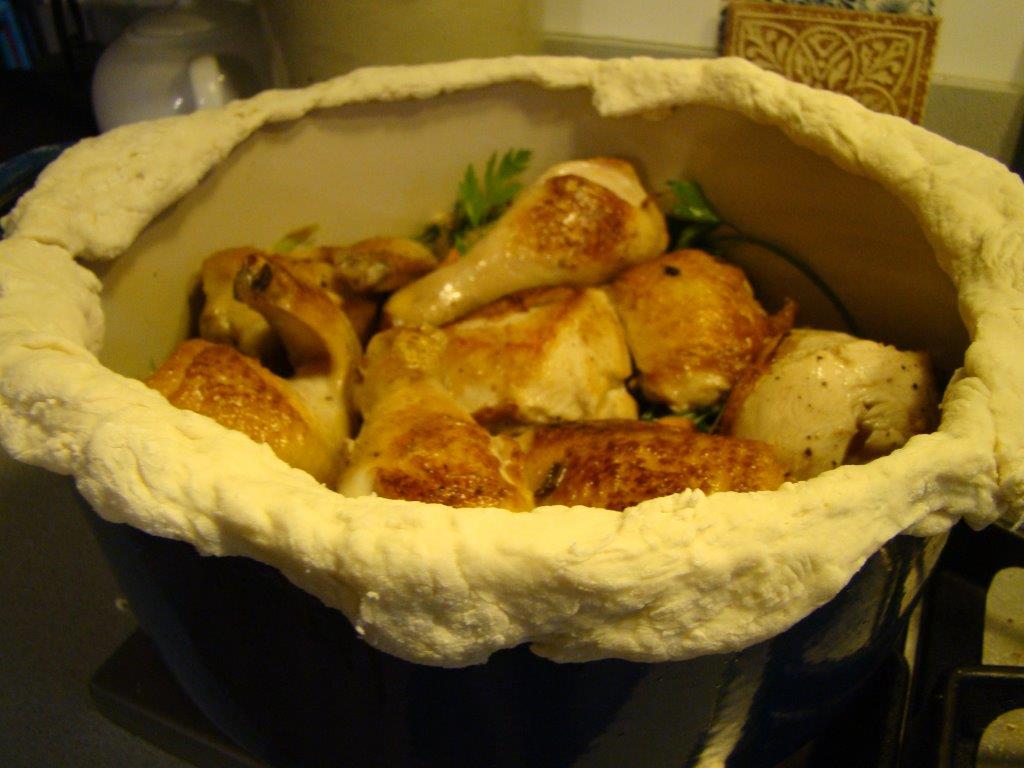
Now comes the fun part! You make a simple flour and water dough, sort of like a soft Play-Doh, just like when we were in preschool, and roll it into a long sausage shape. The dough is pressed along the edge of the Dutch oven, and then the lid goes on top. The dough closes the gap between the pot and its lid, sealing in all the moisture as the chicken in the pot cooks in the oven for almost an hour.

I never tried this dough technique before, but it was definitely fun. The best part was popping it open with a screwdriver when dinner was ready!
I really enjoyed this recipe. The chicken remained moist. I had perched the chicken on top of the veggies, so the skin, while not crisp, wasn’t as soggy as it can get in a braise. The very best part was the sauce. While baking, the liquid in the pot created the most delicious gravy. I had to resist eating it all with a spoon. The chicken was good the first night and then afterwards as leftovers. It’s even company worthy. How perfect to finish up with a winner!
We aren’t quite done with this book. There are a few recap posts coming up over the next few weeks. I’ll wait until the “AMFT Grand Finale” to share my reflections as I look back on this unexpected journey. I might even try to fit in a few makeups for the handful of recipes I didn’t get around to.
For now, I will say that I joined the group for the personal challenge of actually trying every recipe in a book I owned. I was surprised to become part a community that I suspect will outlive the project we’ve just completed. The FFWD community has touched my life in ways I never could have anticipated with a wealth of learning experiences in the kitchen and out plus the added bonus of real-life friendships with people around the world who I would never otherwise have met. I am so proud of what we collectively created.
As a side note, on a solo road trip from Boston to Philadelphia and back this weekend, I was thrilled to share dinner with Tricia and Nana and lunch with Diane. I’m just sorry that, in the excitement, we forgot to take any pictures of us together.
Check out my Dorista friends’ posts here. If you’ve been tempted to try some of these recipes on your own, you can find them all in Around My French Table.
seafood pot-au-feu {ffwd}
(Sniff, sniff! This is the second-to-last recipe that the French Fridays with Dorie group will cook together. I’ll save my reflections for another week, but it seems impossible to be at this point.)
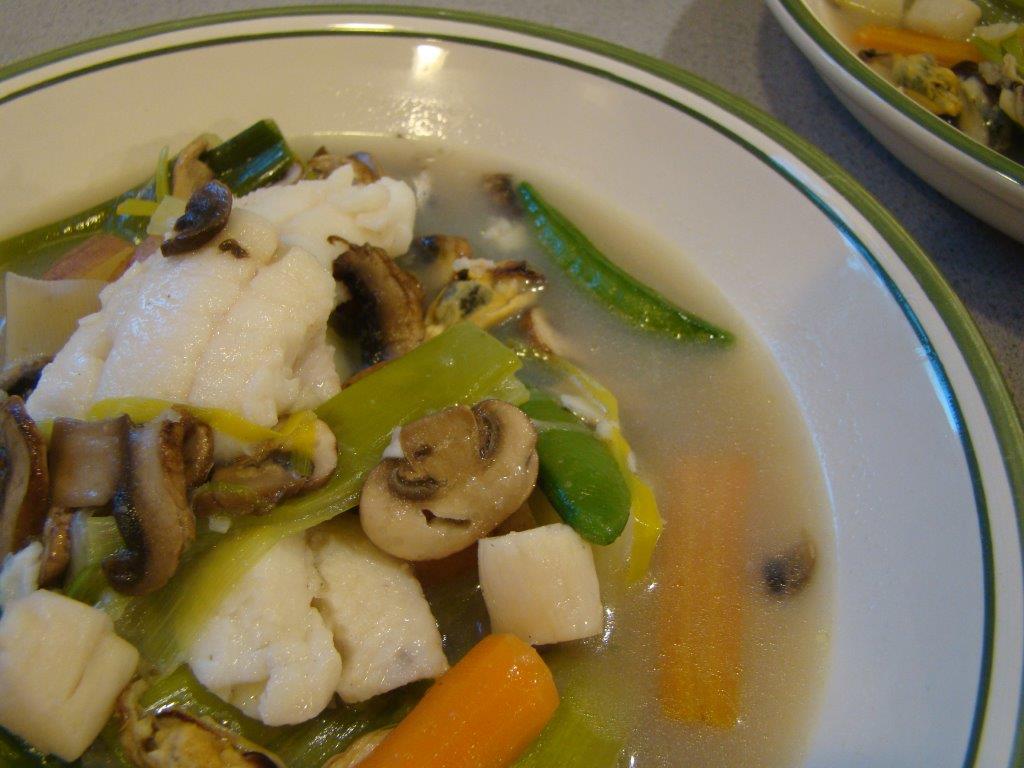
This week’s recipe was the perfect meal for springtime: Seafood Pot-au-Feu. This light, yet filling, seafood and vegetable stew really hit the spot this week.
I was fortunate that someone offered me their weekly fish share from Cape Ann Fresh Catch for this week. A fish share is like a CSA you might have at a farm, but it’s from a collective of fishermen. Quite a novel idea! You don’t know which fish you’ll be getting ahead of time, but I knew I would use whatever I got in my pot-au-feu.
The selection this week was dab. I wasn’t familiar with this fish, but it’s a flat white fish similar to flounder or sole. It was filleted and super fresh. I received 2 pounds, which was A LOT, so I used some in the stew and froze the rest for some meuniere or amandine (or both) in the next week or so.

Two pounds of Dab
The stew starts out by giving the longest cooking vegetables, potatoes, a head start in simmering broth with some aromatics. Then sliced carrots, leeks and scallions are added the pot. I really loved how you can prep the vegetables as you go along. No need for mise-en-place. Finally, sliced mushrooms join the mix. My potatoes needed some extra time, so I just let it cook until the potatoes were nearly tender.

Once the vegetables are cooked, they are scooped from the broth and the mussels are steamed. Then, the mussels are removed and the vegetables go back into the pot. Seems a little fussy, but I think it was worth it because there was no interference when removing the mussels from their shells. I suppose you could leave the mussels in the shell for the diner to deal with. We’ve done that in other recipes. I’m not always in the mood to eat with my fingers, and I found that I liked being able to just enjoy spoonfuls with no fiddling.
Finally, the fish is poached for a few minutes before adding back the mussels, some scallops, and some sugar snap peas to warm everything up. (I partially cooked the snap peas because I had to buy them frozen — not in season yet).

I took a few liberties with the recipe to adjust to what was at hand, but it was no less delicious. As I mentioned, I used dab for the salmon. I substituted homemade fish stock from the freezer for the chicken broth (seemed like a natural fit). I also used double the mussels because they were only sold in two-pound bags. I opted for half a pound of bay scallops instead of sea scallops because they were half the price. The adaptations reinforce that this delicious meal can easily be made with whatever looks best at the fish counter.
We both really enjoyed this. The weather warmed up with a vengeance, jumping immediately to summer temperatures with not much intervening spring (though I suspect that spring will come back). Honestly, I don’t always enjoy hot soup when it’s hot outside, but this worked. It was more like a fish and seafood dinner, eaten with a spoon.
If you want to try this at home, you can find the recipe in Dorie Greenspan’s book Around My French Table. To see other interpretations of this recipe by my Dorista friends, check their links here.
 A Plateful of Happiness