Blog Archives
Birthday Baklava
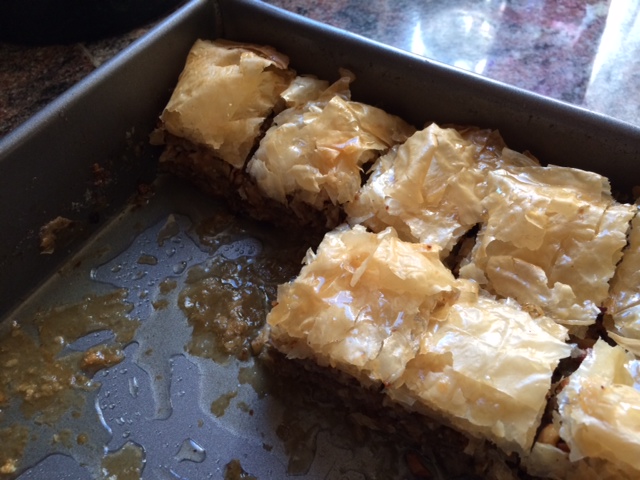
When I visited my sister Jennifer last week, it was my brother-in-law Mike’s birthday. The tradition at her house is to celebrate not just on the day, but for the entire week. Mike recently discovered that he likes baklava. Jennifer had a box of phyllo dough in the freezer, so she thought we could try making a tray of baklava to kick off the week’s celebration.
My niece Rachel joined in on the action. We worked as a team. I laid down the phyllo layers, Jennifer brushed each layer with melted butter, and Rachel was in charge of sprinkling the sugary nuts.

I didn’t use quite the right approach when I cut the sheets to the right size for the pan. I should probably have cut the sheets in half instead of cutting off out the perfect size, leaving the remaining dough in skinny strips. In the end, we needed to use the strips to make enough layers. We saved perfect sheets for the top few layers, and the cobbled-together strips on the inner layers worked out fine.
A favorite thing about baklava is its syrupy goodness. The trick here was to slice the baklava into pieces halfway through the baking time. Then, after it bakes and cools for a while, the syrup is poured over the pastry, oozing into all the crevasses left by the cuts. This leaves a big puddle in the bottom of the pan, but miraculously, all the syrup gets absorbed into the pastry.
While it was time-consuming, making baklava was relatively straightforward. The hardest part was waiting 8 hours for the syrup to get absorbed into the pastry as it cools. It was somewhat miraculous that the puddle of syrup actually disappeared by morning. As a result, though we enjoyed this as dessert, but it’s also excellent for breakfast!
Baklava
Adapted from this recipe from Alton Brown and this one from Epicurious
Filling:
9 ounces almonds
9 ounces pistachios
2/3 cup sugar
2 tsp ground cinnamon
1 tsp ground allspice
1 pound phyllo dough, thawed
8 ounces (2 sticks) unsalted butter, melted
Syrup:
3/4 cup honey
1 1/2 cups water
2 1/4 cups sugar
1 cinnamon stick
6 whole cloves
1 (2-inch) piece fresh orange peel
Heat the oven to 350F.
Place the almonds, pistachios, sugar, cinnamon, and allspice in the bowl of a food processor and pulse until finely chopped.
Trim the sheets of phyllo to fit the bottom of a 13x9x2-inch metal pan. Brush the bottom and sides of the pan with butter.
Place a sheet of phyllo in the pan. Brush with butter. Repeat for a total of 10 sheets. Top with a third of the nut mixture and spread evenly. Layer another 6 sheets of phyllo, brushing each one with butter before laying the next one down. Top with another third of the nut mixture and spread evenly. Layer another 6 sheets of phyllo, brushing each one with butter before laying the next one down. Top with the remaining third of the nut mixture and spread evenly. Layer the final 8 sheets of phyllo, brushing with butter between layers. Brush the remaining butter on top.
Bake for 30 minutes. Remove pan from the oven and cut into 28-30 squares (on a diagonal is nice). Return pan to the oven and continue to bake for another 30 minutes. Remove pan from the oven, place on a cooling rack, and cool for 2 hours before adding the syrup.
Half an hour before the baklava is done cooling, make the syrup.
To make the syrup, combine the honey, water, sugar, cinnamon stick, cloves, and orange peel in a large saucepan and set over high heat. Use a larger pot than you might think you need because it will bubble up when it boils. If it boils over, it will make a big mess. Stir occasionally until the sugar has dissolved. Once the syrup comes to a boil, let it boil for 10 minutes, stirring occasionally. Remove from the heat and fish out and discard the cinnamon stick, cloves, and orange peel.
After the baklava has cooled for 2 hours, re-cut the entire pan following the same lines as before. Pour the hot syrup evenly over the top of the baklava, allowing it to run into the cuts and around the edges of the pan. Allow the pan to sit, uncovered until completely cool. Cover and store at room temperature for at least 8 hours and up to overnight before serving. Store, covered, at room temperature for up to 5 days.
paris-brest {ffwd}
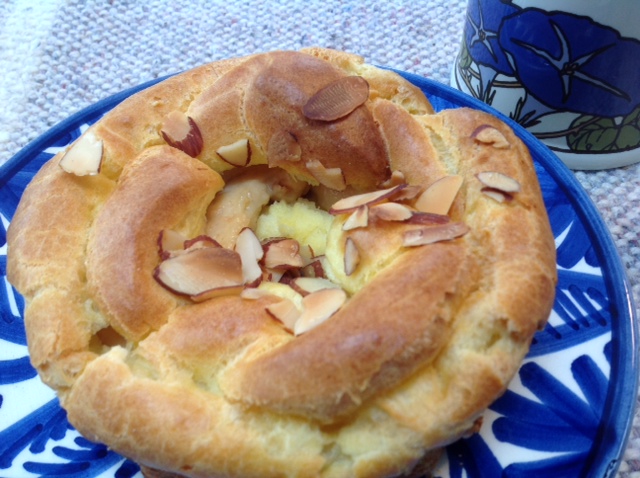
Ambivalence. Dread. Fascination. Resignation. I’ll admit to a full range of emotions about this week’s selection for French Fridays with Dorie: Paris-Brest. What is a Paris-Brest, you ask? It’s a special pastry that was created in honor of a bicycle race. How French! Every four years, the bicycle race is held between Paris and, you guessed it, Brest, a city in Brittany, in northwestern France. OK, that’s the etymology, but what is it? Reminiscent of a bicycle wheel, it’s a ring of choux pastry (the same dough as cream puffs) filled with an almondy pastry cream.
So why the emotional range? Well, even though I’ve made it before, and it’s challenging, but doable, pate a choux is not my favorite dough. Pastry cream? A little intimidating to make, though I think we’ve made it before for FFwD (éclairs?) Not my favorite, loads of calories, and Howard showed no interest in sharing. One concession was to “minify” (nod to Mardi). At her suggestion, I planned to make one small ring for me, form the remaining dough into cream puffs to freeze and save for later. I was further inspired when I saw Christy’s mini rings on Instagram, piped into and baked in mini-tart pans. I had a plan.
First, I set out to make the caramelized almonds that flavor the pastry cream. I didn’t have any whole blanched almonds, only slivered, which have a whole lot more surface area than whole ones. I decided to double the caramel to be sure to have enough coating. It worked out perfectly. Wow! Those caramelized almonds were delicious. We, Howard and I, could have nibbled on the whole batch. The almonds even sparked his interest enough that I varied my plan and made two rings so Howard could try Paris-Brest too.
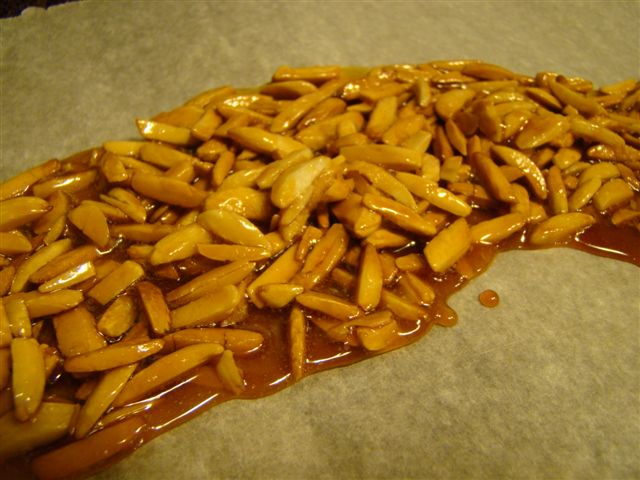
Almond Praline: Next Year’s Holiday Food Gifts?
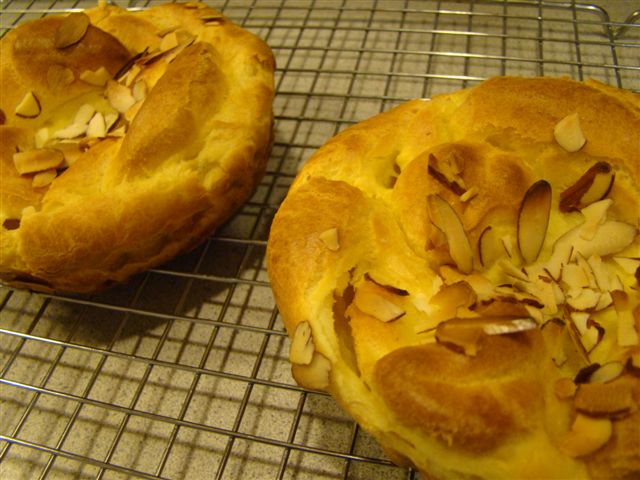
I didn’t have the right kind of pastry tip, so for piping my rings, I made do with a ziplock bag and scissors to cut off its corner. It worked great.
The mini pastry rings were so cute. The center of bottom filled in, but when I sliced it in half to fill, the top still had its hole. I removed most of the dough in the bottom half of the pastry ring, filled it with the pulverized caramelized almonds mixed into pastry cream, and put the other half on top. Then, we waited an hour for the Paris-Brest to chill. A sprinkle of confectioners’ sugar to dress it up before serving, and we had dessert.

I will say that this is a gorgeous dessert. Certainly, it looked like it came from the closest patisserie, not my kitchen. As for how it tasted? It was as good as it looked, if you like this kind of thing. No matter how I try to spin it, custard just isn’t at the top of my list. However, it was a worthwhile experiment, and I impressed myself with a professional looking treat.
We don’t post the recipes, but you can find it in Dorie Greenspan’s book Around My French Table. To see what other Doristas thought of this recipe, check out their posts here.

 A Plateful of Happiness