Blog Archives
Pork Rillettes

Last year, I went with my friend Lauren on an excursion to Cheese Mecca, Formaggio Kitchen, in Cambridge, Massachusetts. Lauren wanted to get a round of Vacherin-Mont d’Or. I tagged along because I love any excuse to visit that store and seldom seem to get there on my own.
I bought a small assortment of domestic artisan cheeses. At this point, I can’t remember which ones. In addition to several cheeses, Lauren also bought a jar of house-made pork rillettes. Since then, I have wanted to make some at home.
Recently, Howard brought up the idea of rillettes. I can’t remember why, but he (we?) probably ate them at a restaurant this winter. I looked up recipes and found that most of the ingredients are pantry items, except the meat, of course, and the steps were simple, as long as you had time on your hands. A snow day when it looked like we’d be housebound, I made sure we had a Boston butt (pork shoulder) on hand, and the day offered the perfect opportunity.

About to go in the oven
Pork rillettes is what the French call potted pork. Pork is slowly cooked until it is falling apart. First, you place the pork shoulder in a pot of water, bring it to a boil, drain and rinse. This is to remove blood and other impurities before proceeding. Then, you put the pork back in the pot, with the aromatics, and water, bring it to a simmer, and put it in the oven for 4 to 6 hours.

Falling apart after hours in the oven
The shreds of meat, along with the flavorful cooking broth, are beaten together to form a pâté. The rillettes are packed into ramekins or jars and sealed with fat. Ideally, freshly rendered pork fat is used. I had trouble sourcing fatback and because of the additives, I didn’t want to use commercial lard. Instead, I salvaged the fat that came to the top when I cooled the extra cooking liquid and made up the difference with a jar of clarified butter (ghee) from Trader Joe’s.
Bella, always begging for an extra treat, was allowed to enjoy the meat that stuck to the fat topping. I melted the fat disks in the microwave and crumbled the meat into her bowl. A little bit mixed in with her kibble = an empty bowl. Dogs are so predictable.
This was a successful experiment! You do not season the rillettes with salt and pepper until it’s time to make the paste. I did underseason the rillettes this time. It needed a lot more salt, but, for this batch, that’s a problem easily remedied as it’s eaten. Rillettes make a hearty appetizer on crackers or baguette slices and topped with sliced cornichons. Elegance on a budget. It is wonderful on a platter with French cheese (or not).
Pork Rillettes
Adapted from Charcuterie by Michael Ruhlman and Brian Polcyn
1 large leek, split in half lengthwise ALMOST to the root, and washed well
1 small bunch of thyme
3 bay leaves
1 celery stalk
8 black peppercorns
1 medium onion, peeled and studded with 5 cloves
3 lbs boneless pork butt, fatty is good
Kosher salt
2 quarts water
Freshly ground pepper to taste
Make a bouquet garni by sandwiching the thyme and bay leaves inside the leek. Bundle the leek and celery and tie together with cotton kitchen string. Crack the peppercorns with the side of a knife or the bottom of a heavy pan and place them in a tea ball.
Preheat the oven to 300F.
Place the pork in a large pot and cover with water by 2 inches. Bring to a boil, then drain pork and rinse it. Place the pork back in the pot along with the bouquet garni, peppercorns, onion, 1 Tablespoon salt, and 2 quarts of water. Bring the pot to a simmer, then cover, and put it in the oven. Cook until the meat is falling apart and tender, 4 to 6 hours.
Remove the pork from the pot and let it cool to just above room temperature. DO NOT DISCARD the cooking broth. Strain the liquid.
Set up your stand mixer with the paddle attachment. Coarsely chop the pork into 1 to 2-inch chunks (it’s OK that it’s falling apart), and add to the bowl. Mix on low speed, gradually adding enough of the reserved cooking liquid, until the mixture becomes a moist spreadable paste. This will take a minute or two. Generously season with salt and pepper to taste.
Pack pork mixture into ramekins or straight sided jelly jars (4oz size or 8 oz wide-mouth work well). Refrigerate until chilled.
Chill any leftover cooking liquid too. If any fat comes to the top, you can use this to seal the rillettes. Otherwise, use other rendered pork fat if you have any or clarified butter (ghee).
Seal the rillettes by heating the fat to melt it. Pour a thin layer of fat ( 1/8-inch) over the rillettes to seal. Store in the refrigerator.
Best served at room temperature (which could take 2 hours after removing from the refrigerator). Consume within 2-3 weeks.
mme. maman’s chopped liver {ffwd}

I did not grow up eating liver. When they set up house together, my parents made a pact to ban their dreaded childhood meal of liver (and Brussels sprouts). However, that meal involved calf or beef liver. Occasionally, when visiting either of my grandmothers, chicken liver, in the form of chopped liver, made an appearance, though, as a child, I was never tempted to try it. (I do think both my parents mother indulged though, so much for consistency in their preferences.) NOTE: My father just called to register his objection to my earlier statement. He tells me he hasn’t eaten liver in any form for well over 50 years, and doesn’t want anyone to think he has. He hates liver. I stand corrected, Dad!
Surprisingly, it was Howard (he who doesn’t like so many things) who recruited me to join “Team Chopped Liver” back in our courtship days. Following in his own mother and grandmother’s footsteps, he always made chopped liver for an indulgent snack. Chopped liver is hardly an everyday food. It’s must be #1 on any list of artery-clogging treats. However, I was easily convinced.
When I mentioned that this week’s choice for French Fridays with Dorie was Mme. Maman’s Chopped Liver, Howard asked how it would be different from what we usually make. His version is a combination of chicken liver, fried onions, and hard boiled eggs. Actually, there isn’t much difference. On paper, there are just three small things.
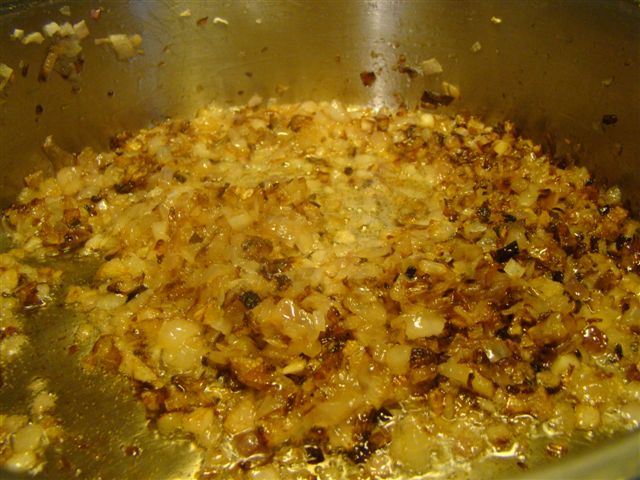
The first is technique. Mme. Maman cooks the onions, and then the livers, in A LOT of oil. The excessive oil allows the onions to brown beautifully. The extra oil is drained off, so the final spread is not overly oily.
The second difference is the addition of quatre épices, a classic French blend of four spices: white pepper, ginger, nutmeg, and cloves. I mixed my own based on this recipe from Gourmet.
The final difference is texture. The liver is coarsely chopped by hand (Howard usually purees the liver in the food processor), so the end result is chunkier than the smooth spread we are used to.
I served the chopped liver (in the new soufflé dishes I bought for another recent recipe) with water crackers and Club crackers. I preferred the flaky, buttery Club crackers. Ritz crackers would also be a good choice, but I didn’t have any of those in my magic pantry.
The verdict at my house was three thumbs up. Or maybe I should say two thumbs (Howard’s and mine) and one dewclaw (Bella’s). The whole family was enthusiastic. I found no need to add any of the extra oil drained off after cooking. The perfect alternative was storing it in a jar and adding a spoonful to Bella’s twice daily bowls of kibble. She’s an extremely finicky eater, but she’s finished every meal this week. Howard even caught her licking the bowl.
I think my enthusiasm puts me in the minority this week. According to the P&Q discussion, many of my Dorista friends are seriously liver-challenged. They were getting creative about faux liver substitutions. To check out their final results, faux or vrai, follow their links here. I highly recommend the vrai version. We don’t post the recipes, but you can find it in Dorie Greenspan’s book Around My French Table.
 A Plateful of Happiness