leeks vinaigrette with mimosa {ffwd}
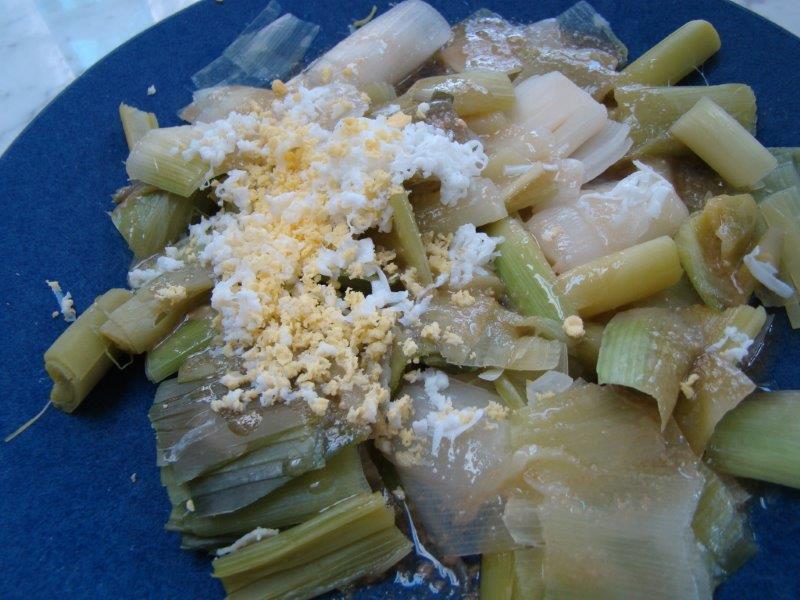
Spring is in full force, both outside my window and, courtesy of this week’s French Fridays recipe, in my kitchen. Leeks vinaigrette with mimosa is an easy salad with a perky mustard dressing that says, out with the heavy fare of winter, and in with lighter foods.
The recipe calls for baby leeks, but they were nowhere to be found around here. I used a bunch of the smallest leeks I could find, though they were still pretty large. The leeks are partially split in order to wash out the dirt between the layers, then tied back together (out of kitchen string like I was? Use some white thread instead) before simmering in water until tender. For my medium-sized leeks, this took about half an hour.
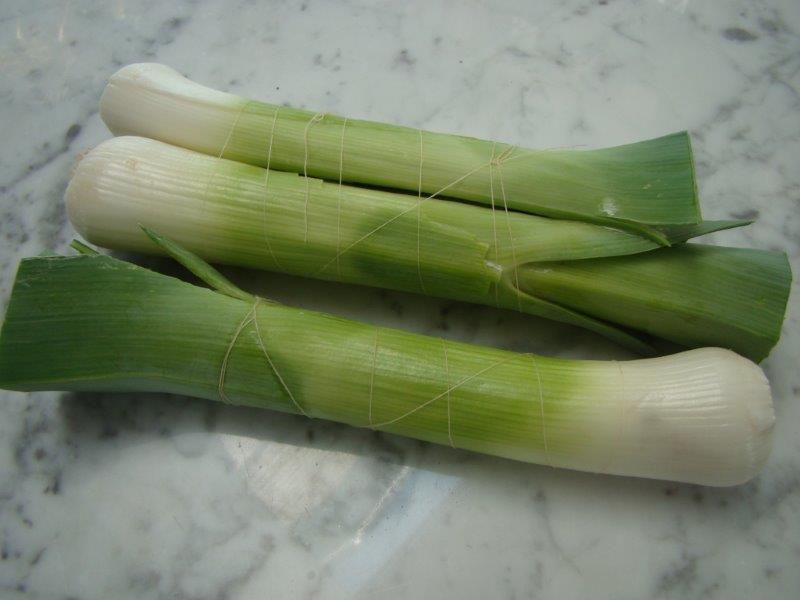
While the leeks cook, there’s plenty of time to make a hard-boiled egg and the aforementioned perky dressing which includes the fancy touches of sherry vinegar and walnut oil.
We have an ongoing discussion in my house on the best way to make a hard-boiled egg. Does one boil the water before adding the egg or does one start the egg in cold water? There’s also the question of whether to cook the egg in boiling water or to to just let it sit in the boiled water. Opinions in cookbooks and the internet are all over the map. The method I’ve settled on is to start the egg in cold water, bring it to a boil, then remove the pot from the heat and let it sit for a certain amount of time depending on the size of the egg (15 minutes for a large egg) before cooling the egg in an ice bath. What’s your favorite way? I’m curious.
After the leeks are tender and dried off with a kitchen towel, they are sliced into thick (1-inch) slices, doused in the vinaigrette and topped with grated hard-boiled egg, which mimics the fringy fluffy mimosa flower.

Mimosa flower (photo from Wikipedia)
This was a delicious side dish, which I served somewhere between warm and room temperature. I was indifferent to the egg garnish. It was pretty, given that the cooked leeks weren’t the most attractive color, but the taste of the egg didn’t come through to me.
Though enjoying this in the warmer weather, I could imagine serving this when winter is dragging me down to remind me that spring will come some day.
If you’d like to know what my Dorista friends thought of their leeks, you can check their links here. The recipe can be found in Dorie Greenspan’s book Around My French Table.
Since I lost my mother in 2007, Mother’s Day is an odd day for me. Though I have fabulous special “mother figures” to honor in my life (a stepmother, a mother-in-law, and an aunt extraordinaire), I now feel something missing. Being childless, I’m not anyone’s mother either. I’ve taken to thinking of Mother’s Day as a day to celebrate all the women in my life, family or friends, independent of motherhood, because these are relationships that enrich my days. So, from me to you, Happy Mother’s Day to all!

My Mom and Me (at her wedding in 1984)
Birthday Baklava
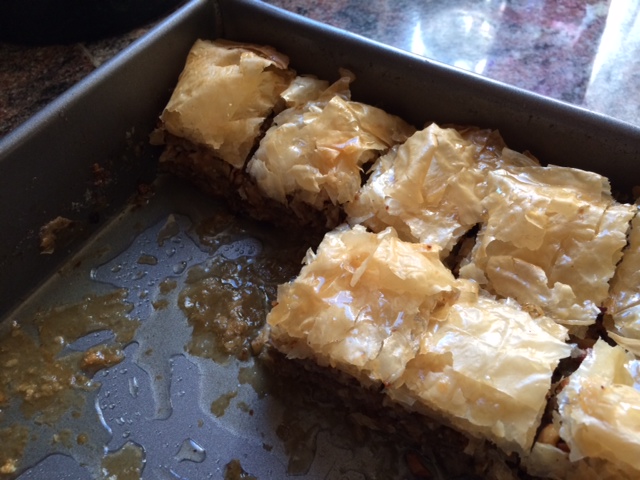
When I visited my sister Jennifer last week, it was my brother-in-law Mike’s birthday. The tradition at her house is to celebrate not just on the day, but for the entire week. Mike recently discovered that he likes baklava. Jennifer had a box of phyllo dough in the freezer, so she thought we could try making a tray of baklava to kick off the week’s celebration.
My niece Rachel joined in on the action. We worked as a team. I laid down the phyllo layers, Jennifer brushed each layer with melted butter, and Rachel was in charge of sprinkling the sugary nuts.

I didn’t use quite the right approach when I cut the sheets to the right size for the pan. I should probably have cut the sheets in half instead of cutting off out the perfect size, leaving the remaining dough in skinny strips. In the end, we needed to use the strips to make enough layers. We saved perfect sheets for the top few layers, and the cobbled-together strips on the inner layers worked out fine.
A favorite thing about baklava is its syrupy goodness. The trick here was to slice the baklava into pieces halfway through the baking time. Then, after it bakes and cools for a while, the syrup is poured over the pastry, oozing into all the crevasses left by the cuts. This leaves a big puddle in the bottom of the pan, but miraculously, all the syrup gets absorbed into the pastry.
While it was time-consuming, making baklava was relatively straightforward. The hardest part was waiting 8 hours for the syrup to get absorbed into the pastry as it cools. It was somewhat miraculous that the puddle of syrup actually disappeared by morning. As a result, though we enjoyed this as dessert, but it’s also excellent for breakfast!
Baklava
Adapted from this recipe from Alton Brown and this one from Epicurious
Filling:
9 ounces almonds
9 ounces pistachios
2/3 cup sugar
2 tsp ground cinnamon
1 tsp ground allspice
1 pound phyllo dough, thawed
8 ounces (2 sticks) unsalted butter, melted
Syrup:
3/4 cup honey
1 1/2 cups water
2 1/4 cups sugar
1 cinnamon stick
6 whole cloves
1 (2-inch) piece fresh orange peel
Heat the oven to 350F.
Place the almonds, pistachios, sugar, cinnamon, and allspice in the bowl of a food processor and pulse until finely chopped.
Trim the sheets of phyllo to fit the bottom of a 13x9x2-inch metal pan. Brush the bottom and sides of the pan with butter.
Place a sheet of phyllo in the pan. Brush with butter. Repeat for a total of 10 sheets. Top with a third of the nut mixture and spread evenly. Layer another 6 sheets of phyllo, brushing each one with butter before laying the next one down. Top with another third of the nut mixture and spread evenly. Layer another 6 sheets of phyllo, brushing each one with butter before laying the next one down. Top with the remaining third of the nut mixture and spread evenly. Layer the final 8 sheets of phyllo, brushing with butter between layers. Brush the remaining butter on top.
Bake for 30 minutes. Remove pan from the oven and cut into 28-30 squares (on a diagonal is nice). Return pan to the oven and continue to bake for another 30 minutes. Remove pan from the oven, place on a cooling rack, and cool for 2 hours before adding the syrup.
Half an hour before the baklava is done cooling, make the syrup.
To make the syrup, combine the honey, water, sugar, cinnamon stick, cloves, and orange peel in a large saucepan and set over high heat. Use a larger pot than you might think you need because it will bubble up when it boils. If it boils over, it will make a big mess. Stir occasionally until the sugar has dissolved. Once the syrup comes to a boil, let it boil for 10 minutes, stirring occasionally. Remove from the heat and fish out and discard the cinnamon stick, cloves, and orange peel.
After the baklava has cooled for 2 hours, re-cut the entire pan following the same lines as before. Pour the hot syrup evenly over the top of the baklava, allowing it to run into the cuts and around the edges of the pan. Allow the pan to sit, uncovered until completely cool. Cover and store at room temperature for at least 8 hours and up to overnight before serving. Store, covered, at room temperature for up to 5 days.
 A Plateful of Happiness