Category Archives: General
Happy Pi Day

You’ve never heard of Pi Day? I suppose I shouldn’t be surprised when people outside my nerdy circle don’t get it. If you remember from geometry, the constant pi = 3.14. It is the irrational number (with an infinite number of decimal places) representing the ratio of any circle’s circumference to its diameter. Today is March 14th (in other words, or numbers, 3-14, or Pi Day).
I have to admit that I forgot about Pi Day this year until my friend mentioned that her daughter had applied to my alma mater MIT. This year, MIT was notifying applicants whether or not they got in today, Pi Day, at 1:59. (To be more specific, pi = 3.14159). I think that is hilarious!
As I’ve said before, I’m happy to turn any day into a food holiday. Pi Day certainly calls for a pie. Honestly, I prefer making tarts to pies, but, today, that wasn’t going to pass muster.
I had Meyer lemons, so I decided to make Meyer Lemon Pie. This is my own invention, but it’s really just Key Lime Pie, with Meyer lemon juice instead of Key lime.
If you’re not familiar with Meyer lemons, you should get acquainted. They are from California. Compared with a regular lemon, the Meyer lemon is smaller and a bit rounder; the skin is smoother and has a slight orange tinge. They are very fragrant with a floral lemon flavor. They aren’t quite as tart as a lemon, but the flavor is definitely lemon. They are definitely worth trying when you are lucky enough to see them at the market.
This pie starts with an easy graham cracker crust. I usually do it the day before I’m going to bake the pie.
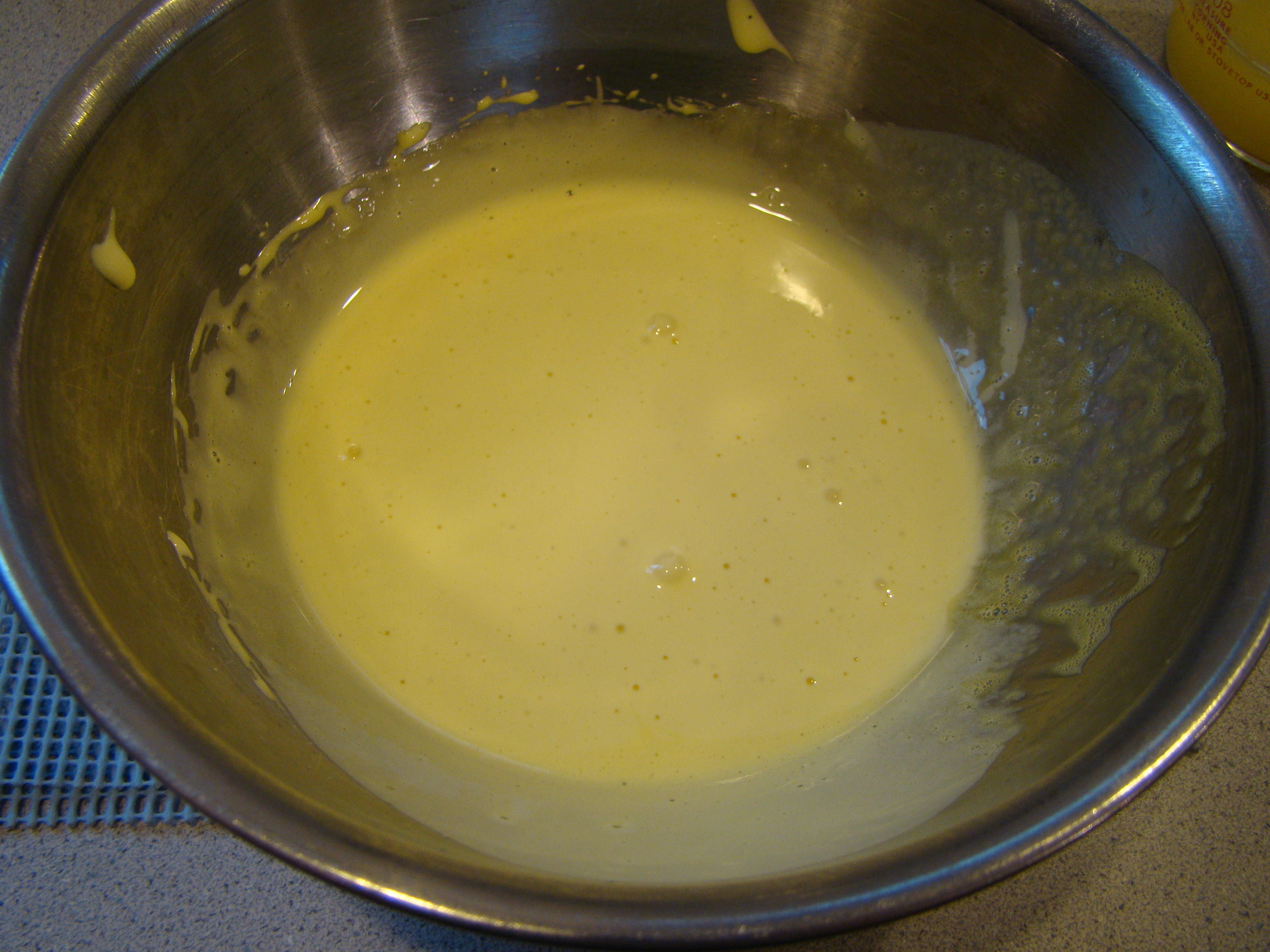 I think the real secret to this pie is how long you beat the egg yolks. I beat the egg yolks with an electric hand mixer for a full 5 minutes. The egg yolks transform from a deep yellow to a buttery yellow. It always surprises me that the color can change so much just by incorporating with air. The end result is a light, smooth, and creamy pie.
Meyer Lemon Pie
Serves 8
1 9-inch graham cracker crust (see recipe below)
4 large egg yolks
1 can (14 oz) sweetened condensed milk
½ cup Meyer lemon juice (from 3-4 lemons)
½ tsp Meyer lemon zest
Preheat the oven to 350F. Beat the egg yolks with an electric mixer at medium speed for 5 minutes, until they are light yellow in color. Add the milk, juice, and zest, and beat until well blended.
Pour the filling in the crust. Bake until the filling is set, but still creamy, about 15 minutes.
Cool the pie completely on a rack. Then cover and chill for at least 4 hours before serving. Use foil, instead of plastic wrap, because the plastic wrap tends to sag and stick to the top of the pie.
For a Key lime pie, substitute Key lime juice (I use bottled) for the Meyer lemon juice and omit the zest.
Graham Cracker Crust
Makes 1 9-inch crust
1¼ cup graham cracker crumbs (I use the low-fat crackers)
2 Tbsp sugar
1/3 cup butter, melted
Preheat the oven to 350F.
Combine the crumbs and sugar in a small bowl. Add the melted butter, and stir together with a fork until it is mixed well.
Press the mixture evenly over the bottom and sides of a 9-inch pie plate. Bake for 8 minutes. Cool completely on a rack.
Guest Blog: Howard on Sous Vide
If you have been reading Betsy’s blog, you will notice that she enjoys cooking, a lot. Part of her joy in cooking is how she can relax while putting together an amazingly great meal in an hour or so and escape from her high tech software career with pots, pans and knifes. For me, the joy of cooking comes from the thrill of slow cooking food, such as the the slow BBQ of ribs or a brisket in a Texas smoker for 4 to 10 hours. But this is a warm weather activity, so during the colder seasons, I combine slow cooking with my many years of experience in the lab. (Ask Betsy how she enjoyed the trips to the lab to check on my experiments in the “warm room”).
There is a cooking technique called Sous Vide, French for “under vacuum”. I will explain the reason for the name later. The goal of Sous Vide is to cook food to a thermodynamically stable state in contrast to a specific kinetic time point. I’ll bet you didn’t expect to run across these terms in Betsy’s cooking blog. So much for her inviting me to be a guest blogger.
What does this all mean? Normally, food is cooked for a certain amount of time to reach a final desired temperature; say, for a rare steak, cooking it for 15 minutes over a 500F fire to reach an internal temperature of 125F , or, maybe, roasting a chicken for 1 hour in a 350F oven to reach an internal temperature of 180F. In these examples, cooking longer than the 15 minutes or 1 hour causes the food to overcook. This is what I mean by a specific kinetic time point. Get the time right, and the food is ready: too short of time and it’s undercooked; too long of time and it’s overcooked.
However, even when done correctly, the food actually has a temperature gradient from the outside to the inside. The outside of the steak is at 500F while the center is 125F. Cook a thick enough steak, and it becomes very hard to get the steak right without under- or overcooking the steak. The same is true with poultry or any other food. It’s just very difficult to get all the food to a single uniform temperature. Instead, consider setting the heat source to 125F or 180F. Cook the food long enough, and it will reach exactly 125F or 180F. It might take a while to cook, but no matter how long it’s cooking, the food can’t overcook. This is the thermodynamically stable state.
 Most ovens can’t cook at 125F or even 180F reliably. This is where my lab experience comes into play. In lab, we need to conduct experiments at a number of different temperatures. This is commonly achieved with water baths: metal tubs filled with water and heated with an electric coil controlled by an electronic thermostat. Some baths can be set as accurately as 0.1 F. So, knowing that every well-equiped kitchen needs its own accurate water bath, I bought an immersion circulating heater on eBay and rigged it to work placed in a pot of water. (N.B. The temperature display says 79.7 but that is Celsius, its about 180F.)
 Putting food into a water bath of this sort would cause most of the flavor to be washed out, sort of a low-temperature New England boiled dinner. This is where a seal-a-meal bag comes to the rescue. If the food is placed in a bag with spices and then sealed under vacuum (hence the origin of the cooking style “Sous Vide”) with the FoodSaver, the whole bag can then be placed into the pot, left until the food reaches steady state and then enjoyed at the finally desired temperature.
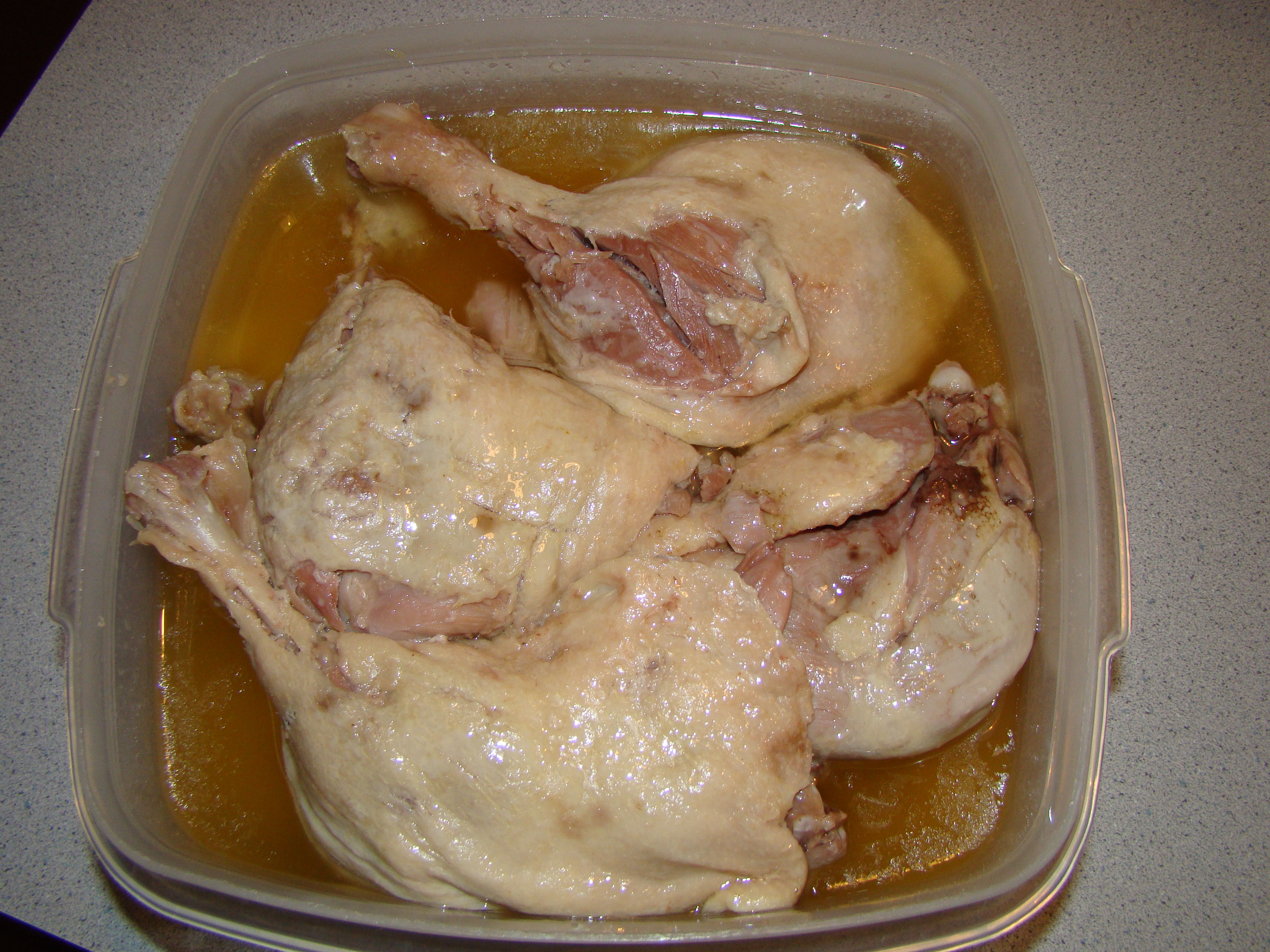
I have cooked a few different cuts of meat like this: Short Ribs, Fish, and Duck. This week, I made Duck leg confit. I have made this a number of times. Here’s how:
Duck Legs Confit, Part 1, the first 60 hours…
8 legs (1.95 Kg/4.31 lbs)
34 g salt (1.2 oz)
24 peppercorns
16 cloves
3 cloves garlic, sliced thinly
Coat the bottom of a glass baking dish with half the salt. Layer the legs in a single layer in the baking dish. Cover the legs with the remaining salt. Distribute the peppercorns, cloves and garlic slices over the legs.
Cover with plastic wrap and store in the refrigerator for 48 hours. (If you are in a rush, you can take them out after 36 hours.)
Rinse well and dry.
Place 4 legs into a seal-a-meal bag. Add 1 Tbs duck fat, and seal the bag. Repeat with the other 4 legs.
Place the bags into a 180F water bath.
Cook for 12 hrs (yes, twelve hours). Remove the bags from the bath and chill. Leave in refrigerator for a month or more. You don’t want to eat them right away.
I will be back then to discuss preparing the duck legs confit in Part 2.
 A Plateful of Happiness