Category Archives: Fish
tuna confit with tomato salsa and tapenade {ffwd}
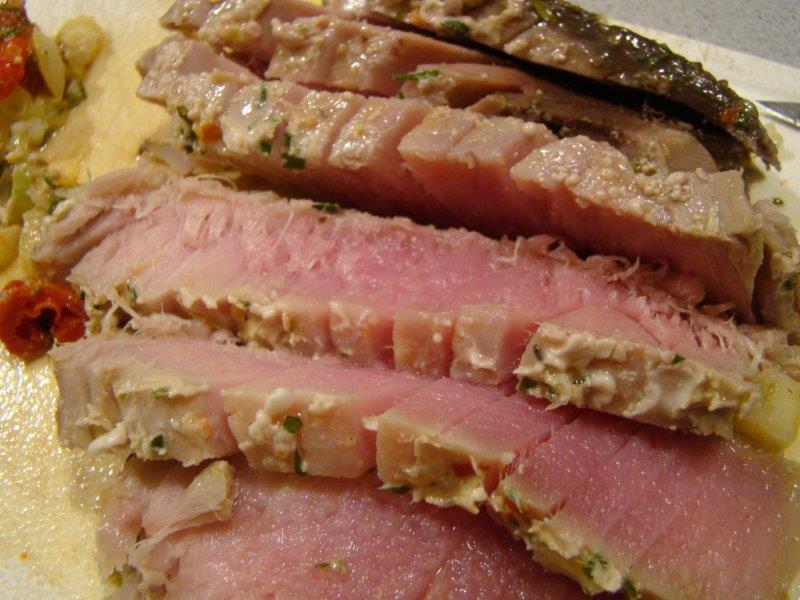
Confit is an ancient French preparation for cooking and then preserving meat in its own fat. This is classically done with duck (a favorite at my house) and sometimes pork. This week’s recipe for French Fridays with Dorie was something more modern, but in the same spirit: Tuna Confit. In the case of the tuna, which doesn’t really have any fat that would render during cooking, it is mixed with a variety of aromatic seasonings, then covered in olive oil. First, the tuna marinates in this oil bath for the day, then spends an hour in the oven at a very low temperature, before being sliced and served with a summery tomato salsa and some olive tapenade.
Over the weekend, I scoped out availability and price of tuna. Whole Foods had it, at $25/pound. I wasn’t planning to make the tuna until later in the week, so I thought I’d come back later in the week. I also decided that at that price, I’d make a half batch. On Tuesday, I went back to Whole Foods, but they were out of tuna, and didn’t expect more until Friday. Ugh. I stopped at another store with a decent fish counter, but they didn’t have any either. As a last try, I checked at Trader Joe’s. Though I don’t usually buy it, I remembered they carried frozen fish. Well, the stars aligned in my favor. Not only were there ahi tuna steaks in the freezer, but they were only $9/pound. The packages were about a pound, so a full batch it would be.
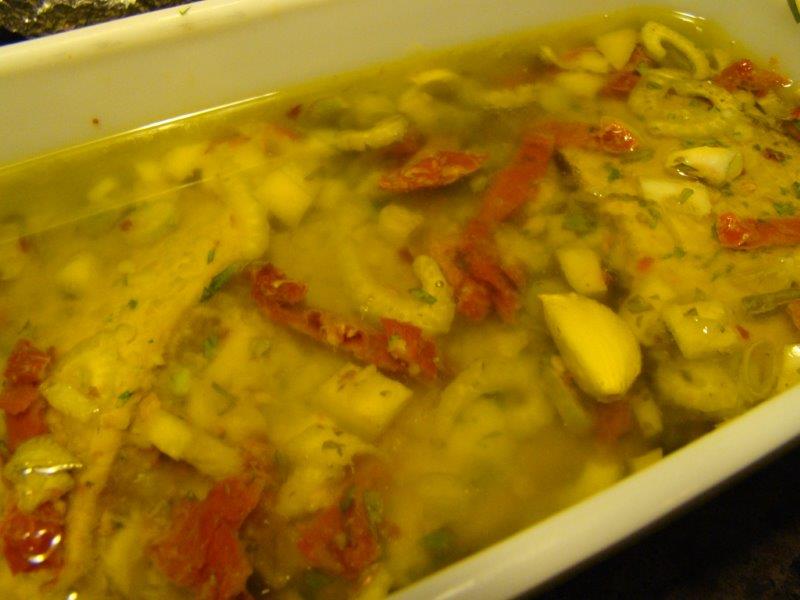
Tuna in Its Oil Bath
Whenever a recipe calls for preserved lemon, as the tuna confit does, I always make a batch of Mark Bittman’s quick preserved lemons, which takes only 3 hours, no more advanced planning than that required. In addition to preserved lemon, the tuna is flavored with fresh lemon (juice and zest), sun-dried tomatoes, scallions, garlic, celery, and fresh herbs. Besides smelling extremely fragrant, I loved how colorful the mixture was.

The colorful theme continued with the tomato salsa that tops the tuna. Chopped cherry tomatoes, fresh from my garden, along with diced pepper (both fresh and pickled) and more preserved lemon. I’ve been trying to avoid using the word “confetti” because I overused it a few weeks back, however, it’s the perfect word, so I have to use it to describe how the salsa looked.
I served slices of the warm and rosy tuna, topped with the cooking mixture, the tomato salsa, and a dab of (green) olive tapenade with some leftover Swiss chard ravioli on the side. Delicious!
Even better was night #2 when I used the tuna as the star of a salad Niçoise. I tossed lettuce and cherry tomatoes with a light mustardy vinaigrette for the bed for the salad. Then, I topped this base with steamed potatoes chunks tossed with the same dressing, slices of cold tuna confit with leftover tomato salsa and tapenade spooned on top, and these unusual green beans tossed with a chorizo dressing (sort of like a meaty Romesco sauce). The final composition made a fabulous dinner.

Some of you might groan, but I didn’t like it quite as much as Salmon in a Jar. Head-to-head, it would be a close contest. Used as an ingredient, there are so many possibilities for what to do with the tuna confit that the gears in my brain are turning. Howard wants to give this a whirl with one of us sous-vide devices. I suspect we’ll be making this one again.
If you want to try this yourself, check out the recipe (in two parts) at the Washington Post (part 1 and part 2). Of course, you can always find it in Dorie Greenspan’s book Around My French Table. To see what the other Doristas thought about tuna confit, follow their links here.
dilled gravlax with mustard sauce {ffwd}

Howard is a master of gravlax. For many years, it’s been his signature appetizer for special parties. With French Fridays with Dorie’s gravlax on the schedule, we decided it was time for a throwdown challenge. I’ll admit to not doing any of the cooking. I was in charge of the shopping for this one. It’s not that I had anything against the recipe, but wanted an equally experienced touch for a better comparison of the two recipes.
I bought a large side of salmon, about 3½ pounds. We cut it in half crosswise and Howard made each half with a different recipe. The basic process for gravlax is to coat the fish with herbs and a sugar/salt curing mixture and leave it, pressed under weight (i.e. cans), in the refrigerator for 2-3 days. During its cold rest, the rub draws moisture out of the fish, curing (cold cooking) it.
The first difference between the two recipes is the flavoring. Dorie adds black and white peppercorns plus coriander seeds to the rub. Howard only adds white peppercorns to his dry mixture, though he rubs the fish with some aromatic liquor first. This time he used Pernod, but aquavit is good too. The main difference is the proportions of sugar and salt in the curing mixture and the total amount of dry rub used. Dorie uses a 3:1 ratio (yes, I’m a math geek) of salt to sugar, and the total amount of rub is just a few tablespoons. Howard uses the opposite: a 2:1 ratio of sugar to salt, and the total amount is a little over two cups.
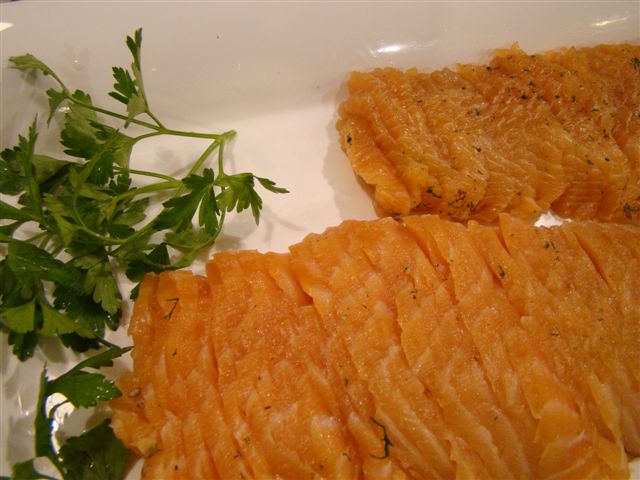
Gravlax Throwdown:
Dorie’s in upper right, Howard’s on bottom
As I said, this is Howard’s signature appetizer for special parties, and we had the perfect occasion. Every year, we celebrate Christmas Eve with longtime friends who make the traditional celebratory Feast of Seven Fishes. All the guests bring contribute dishes to for the meal. This year, the game plan was to start with an abundant appetizer extravaganza accompanied by a festive punch and other drinks. We brought both styles of gravlax for a broad tasting. (I made mini-crab cakes.) Later in the evening, we sat at the table to enjoy a delicious Niçoise salad, followed by bourride, a French fish stew heavily laced with aioli. Dessert is an array of home-baked cookies, just the right size to fit into any empty parts of your belly. As always, it was a fantastic meal, one we look forward to all year!

Mini-Crabcakes, ready to be baked at the party
The two styles of gravlax had similar texture and were both delicious. Howard’s “original” version gave off considerably more liquid during the curing process and was firmer than the one prepared Dorie’s way. Dorie’s version was also a little harder to slice thin, probably because it wasn’t quite as firm. We brought half of each half to the party, and there was very little leftover. Both were quite popular with everyone. We’ve been enjoying the salmon we kept for ourselves on bagels with cream cheese in the mornings for the past few days. What a treat!
So, what’s the verdict? I’d say that if we’d never made gravlax before, this recipe would become a standard in our repertoire. However, it isn’t different enough than Howard’s usual recipe, so that recipe won’t get displaced. The recipe is definitely a good one, so I urge you to try it if you’ve never made gravlax before.
Dorie gives a recipe for a dilly mustard sauce to accompany the fish (which I forgot to take a picture of). We didn’t do a side-by-side comparison of her sauce to our usual. Dorie’s was similar and equally delicious. Her recipe uses using much less oil that the other, so it’s healthier. While the gravlax recipe wasn’t different enough to mandate a switch in the future, her sauce is a new keeper.
You can find the recipe for both the gravlax and the sauce in Dorie Greenspan’s book Around My French Table. It’s also on-line at Epicurious. You can also read about other Dorista bloggers’ gravlax by following their links here.
In case this is my last post of the year (though that isn’t my plan), I wish you all a Happy New Year! May the year ahead be filled with love and laughter, and of course, good food! I’m looking forward to sharing many more kitchen adventures in 2014.
 A Plateful of Happiness