Category Archives: Baking
tuesdays with dorie / baking with julia: bagels
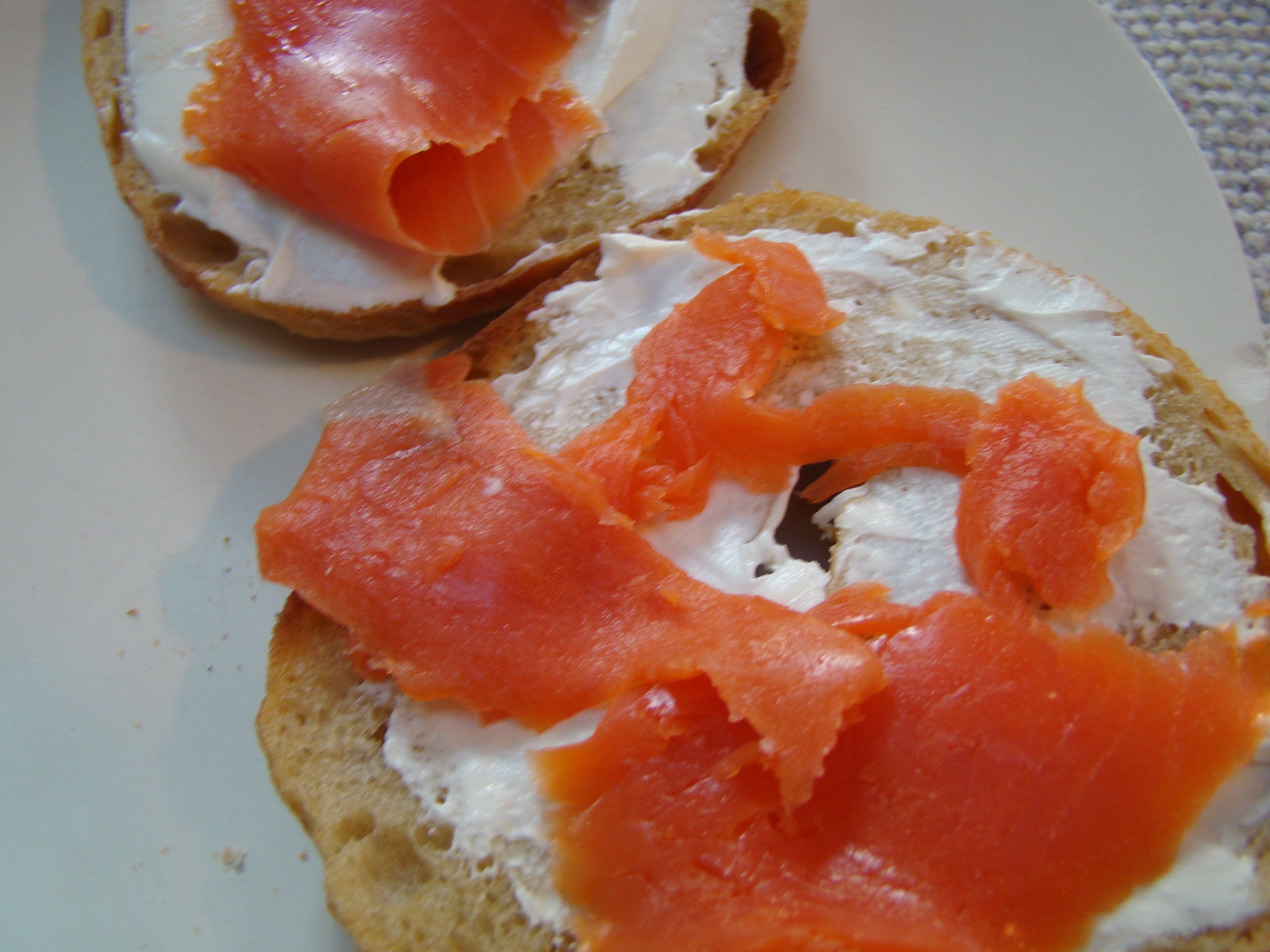
Oh, memories of the bagels of my childhood! The big event of every Sunday morning was to be the lucky one to take a ride with my dad in his convertible, top down when weather permitted, to the BagelMaster in Wheaton, Maryland. We waited in line and ordered our selection. Then, my dad allowed the one exception to his otherwise inviolable rule about eating in a car, which applied not only to his convertible but even to the family station wagon. On the ride home, you could eat a bagel, but only if that bagel was hot. If the bagel wasn’t hot out of the bakery’s oven, no eating allowed. Best of all was when the hot bagel was a salt bagel!
Over the past couple of decades, “real” bagels have become a distant memory. In the olden days, bagel flavors were limited to plain, seeded (poppy or sesame), pumpernickel, garlic, onion, salt, or egg. There was no such thing as a blueberry bagel, cinnamon raisin, or anything that made a bagel resemble a baked donut.With bagels’ popularity has come a serious decline in their quality. Most bagels I find now are simply “rolls with holes”, puffy and soft, not at all crusty. The Montreal-style bagels from Iggy’s are acceptable, but still not quite the ideal I’m always searching for.
When I saw that the crowd for Tuesdays with Dorie / Baking with Julia was making bagels this week, I knew I had to try it out for myself. How would Lauren Groveman’s recipe for homemade bagels compare to the ones in my memory? Or would they be like the ones from the supermarket that I disdain?
The recipe was imposing, taking up several pages to explain the steps. There was the usual mixing, kneading, and rising as for any bread, but what makes a bagel a bagel is the shape and the boiling before the baking.
The ingredient list caused me a little bit of angst as it called for a few tablespoons of vegetable shortening. I asked the other bakers about substitutions. Butter seemed acceptable, but someone mentioned that she’d seen recipes without any added fat. I did my own search through various cookbooks, and, in the end, just left it out, without any substitute.

I used my stand mixer to mix and knead because it’s so easy to do. I added the full 6 cups of bread flour. The dough was still soft and sticky, though also seemed smooth and elastic. I decided not to add more, but I think I should have. The dough was very sticky, and the liberal flour on my hands ended up adding more flour to the dough anyway. The dough rose once, and then went into the refrigerator overnight to rise again. The second rise resulted in a lofty rise with a few big air bubbles on the surface.
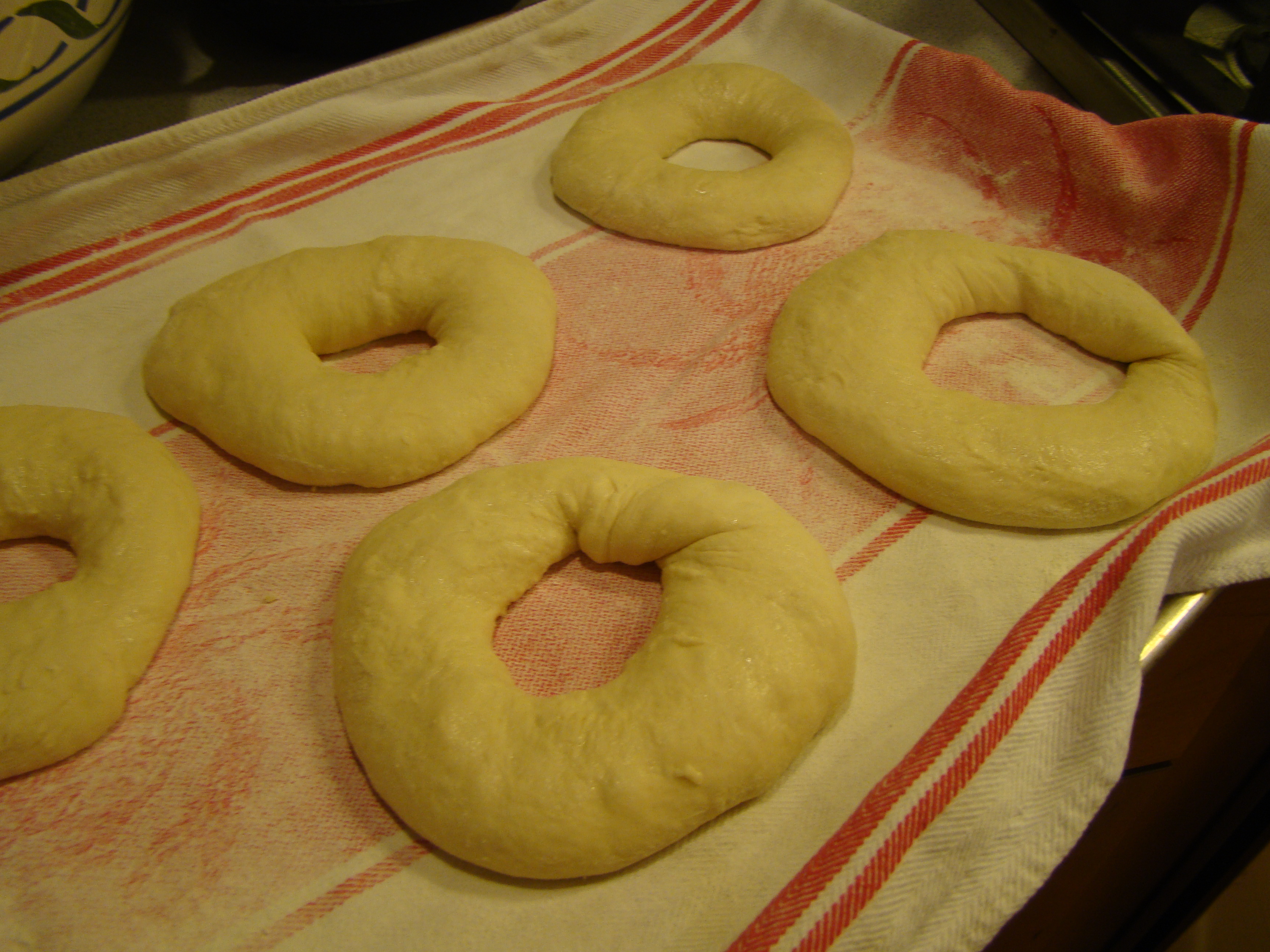
Bagels were made in two batches, I assume because it’s best to bake only one sheet at a time. First, you form the dough into bagels. The hole is supposed to be extra big because it shrinks as it boils and bakes. Though I had a huge hole in my hands, it seemed to shrink immediately when I placed the shaped dough on the baking sheet. It deformed again when I transferred each bagel into the pot of boiling water. I’m not sure whether this was something I need to practice, or whether it was because the dough was a little too soft.

The bagels were boiled on both sides, then brushed with egg wash and sprinkled with toppings. The bagels are baked in a very hot oven, with ice cubes thrown on the oven floor to create steam.
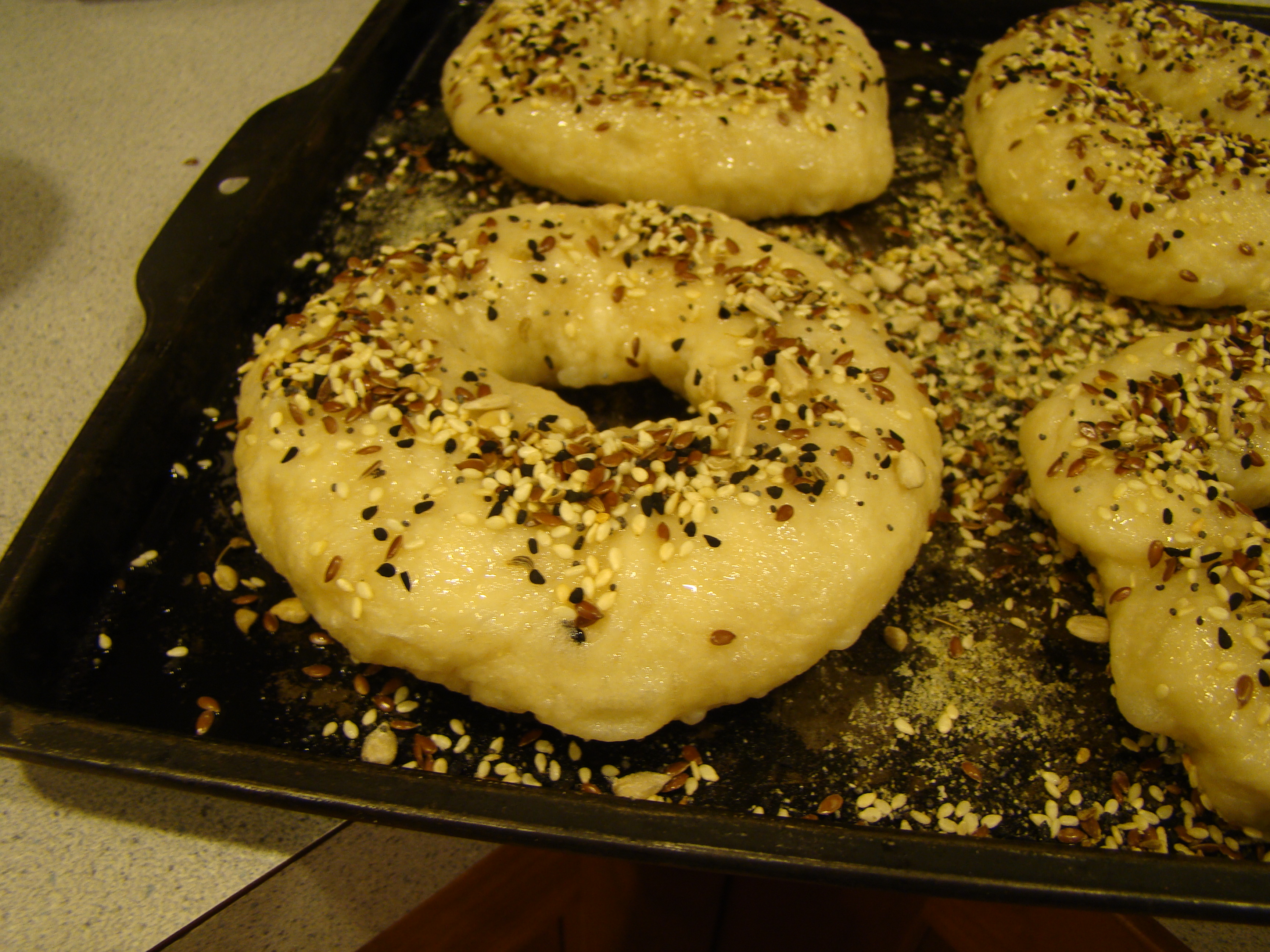
I made a few different varieties. The first batch was seeded. I used an artisan seed mix from King Arthur with poppy, sesame, caraway, flax, and sunflower seeds. The first batch of bagels had topping on both sides because I mixed the seeds with the cornmeal when dusting the baking sheet, so seeds stuck to the bottom too. For the second batch, I topped half of them with rehydrated garlic chips and the other half with kosher salt.
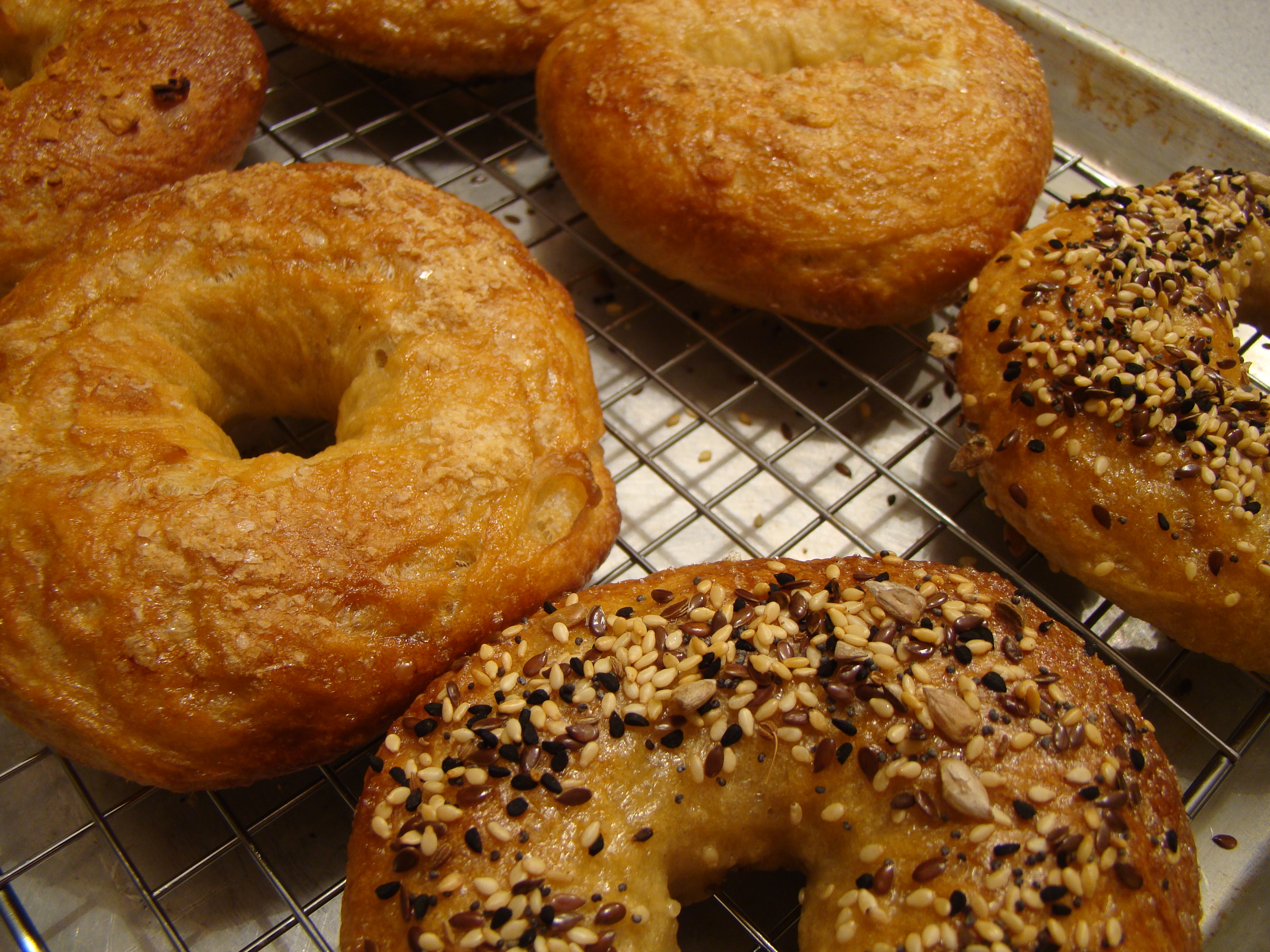
Verdict? These bagels put a big smile on my face! They had the remembered crust and were appropriately chewy. They were great hot and also good toasted. I thought they were pretty close to what I remembered. Husband Howard says they aren’t quite what he remembers from his New Jersey childhood, but closer than most of what we get today. I used bread flour, but I wonder whether high-gluten flour would bring it even closer to what used to be, so I’ll try that in the future.
The homemade bagels were worth the effort, and I would make them again. The steps are less work in execution than they seemed on the page. Because of the overnight rise, I could make hot bagels for a weekend breakfast by getting up an hour earlier than usual.
If you want to make these yourself, this week’s host, Heather of Heather’s Bites, shares the recipe in her post. The recipe can also be found in Dorie Greenspan’s book, written with Julia Child, Baking with Julia.
And to see how the other bakers made out, you can follow their links here to read all about it.
Happy Tuesday!
ffwd: crispy-crackly fig-apple-and-almond tart

I’ve always found phyllo dough to be challenging to work with. Those paper-thin sheets are just dying to tear as you delicately peel them off the pile. So, when I saw that this week’s recipe for French Fridays with Dorie for Crispy-Crackly Apple-Almond Tart was built on a crust made of layered phyllo dough, I felt a touch of dread.
Deep down, I think the trick with phyllo dough is “practice makes perfect”. It’s all about comfort and confidence. So, I forged ahead. For this elegant tart, the base is built by oh-so-carefully transferring a sheet of phyllo to the baking sheet, brushing it with melted butter (still carefully), sprinkling with sugar (I used turbinado sugar and sprinkled with abandon, using way more than called for), and repeating. A few of the early sheets had tears that could be hidden, and I had to discard a sheet or two, but that’s why it comes twenty sheets in the pack, I guess.
Next comes the almond cream, also known as frangipane. Almond flour, egg, sugar, vanilla, and cream are whisked together to form a thick paste. This is spread, most carefully over the crust. I tried to leave a little border, but it obviously wasn’t enough of one, because the almond cream oozed over the edges while I was working on the fruit. It still tasted good, but didn’t help with aesthetics.
Finally, the tart is topped with fruit. At the market, a basket of figs called my name, so mine was intended to be a crispy-crackly fig-almond tart. I couldn’t decide whether to place the figs cut side up or down. I’m not sure I love the look of my choice. Unfortunately, the figs didn’t quite cover the top surface, so I added two rows of sliced apples to fill the space. Because I didn’t anticipate this, my fruit arrangement was not symmetrical so looked far from “bakery-ready”.
 The apple slices were challenging, trying to keep them fanned together while transferring them to the tart. I felt like I was playing some kind of motor-skill game that I wasn’t winning. Had I aimed to make a fully-apple tart, there is no way that three apples would have covered the tart. I’m not sure whether Dorie’s apples were huge, or whether she spread her apples less densely. The two crosswise rows of apples on my tart used one and a half apples. I would have needed 4 or 5 to cover the whole thing. I liked the closely packed look, but this was definitely another recipe where a photo would have been very helpful to see the intent.
When the tart comes of out of the oven, there’s one final step, to glaze the top with melted apricot jam. This gives the tart a lovely sheen and a touch of additional sweetness.
On baking, the almond cream spread some more, so I didn’t get many crackly edges. However, the crust still crisped up underneath, so each bite had plenty of crisp and crackle. The figs tasted good, but I preferred the apple. Sliced leftovers look terrific in the cake dome.

Having made this for a weeknight dessert for two, I felt a little like my tart deserved a better audience, like a little black dress with no party to go to, just the kitchen table. I have some work to do on the final appearance. I’m thinking I might like this better fitted into a rectangular tart pan, where the edges will contain the gooey filling without going where it shouldn’t. I do plan to pull out this crispy-crackly tart recipe the next time I’m asked to bring dessert to someone’s house for dinner: the well-deserved party for my elegant (and easy) dessert. If you want to try this one, invite me over!
We don’t post the recipes, but you can find it in Dorie Greenspan’s book Around My French Table. To read about the other FFWD bloggers’ tarts, follow their links here.
 A Plateful of Happiness