Monthly Archives: June 2011
French Fridays with Dorie: Cola and Jam Spareribs

It is with a heavy heart that I write my post about this week’s recipe for French Fridays at Dorie. I’ve learned some new techniques, explored new combinations of ingredients, and experienced some new flavors. It’s been a new adventure every week. After nine months of cooking from this fabulous cookbook, this week I hit my first complete dud: the Cola and Jam Spareribs.
In my house, when it comes to big slabs of meat, particularly ribs, this is normally my husband Howard’s domain. His usual treatment is a long, slow cook on his fancy Texas smoker. When I announced this week’s recipe, Howard was initially doubtful. But, over many months of my cooking from the book, he has faith in Dorie, too, so kept an open mind.
We were expecting guests (my friend and two teenaged girls) so doubled the recipe and made two racks. The ribs are rubbed with fragrant ginger and five-spice powder. The glaze was a mix of orange juice and apricot jam (Stonewall Kitchen’s Apricot and Ginger Jam) with a dosage of Coca-Cola for the final hour. The preparation was quite simple.
The only preparation glitch was that I didn’t check with the in-house Coke drinker (Howard) and made the faulty assumption that we had cans of Coke in the basement. We were out of stock, so someone had to make an extra trip to the store while the ribs did their initial roasting.
The ribs looked great as they cooked. I had to open the oven for basting, and it smelled good too.
Unfortunately, when we served dinner, Howard and I were completely underwhelmed. The sweet stickiness suggested by the bubbling glaze was absent from our tastebuds. The ribs themselves were a little chewy, certainly without the melting off the bone quality from a smoker. It was a total disappointment. (My friend said they were good, but I think she was just being polite.)
In the end, the teenagers opted out, and didn’t show up for dinner, so there were plenty of leftovers. After bringing ribs for lunch on the day after, Howard and I both sheepishly admitted to each other that we weren’t enjoying the ribs and neither of us wanted to bring them for lunch again. I ended up tossing out a full rack of spareribs. I hate wasting food, but I just couldn’t make myself eat them again.
I’m really not sure whether I did something wrong or it just wasn’t to our taste. I did add water to the pan to keep things moist, but, because the pan was almost borderline dry between bastings, I can’t imagine that I added enough water that it diluted the flavors.
I’ll chalk it up to “you win some, you lose some”. I’ve cooked close to 40 recipes from this book, and, as I said, this was the first loser (to me), so the odds have been favorable.
I can’t wait for next week’s recipe: Roasted Rhubarb. I already know I’m the only one who will eat it at my house, but if, it comes out as I hope it will, it just means more for me.
Click here for links to other bloggers’ posts on these ribs. Hopefully, they had a better experience than I did. Until next week…
Duck, Duck, Goose

I love duck. More specifically, I’m a dark meat kind of girl, so that means I love duck legs. For heaven on earth, duck legs as duck confit can’t be beat. Confit is a form of food preservation where the meat is cooked slowly in its fat and then stored, encased in the fat for longer storage.
Fortunately for me, when Howard first started with his sous vide experiments, he easily mastered duck confit during his early efforts. Because the meat is cooked in vacuum-sealed bags, the duck renders enough fat for this process, more or less, which is much less overwhelming than the quarts of duck fat called for in recipes that are cooked in a pot. He actually wrote this up for an earlier “guest post”. It was our only duck confit failure because that time, he tried something new and decided to store the duck out of the bags in a plastic container, still in the refrigerator. The problem was the fat didn’t completely cover the duck and it spoiled (hence no Part 2). You can read about Part 1 here.
This put Howard off making this for quite a while (it’s been over a year). He recently tried again. I’m happy to report he’s back on his game, and it was good as ever. Once made, With the duck confit stashed in the refrigerator (in their vacuum sealed bags), it’s practically fast food. The final preparation is to broil the duck legs to crisp up the skin. The contrast of the meltingly tender meat (it’s falling off the bones) and the crispy skin is a delight.
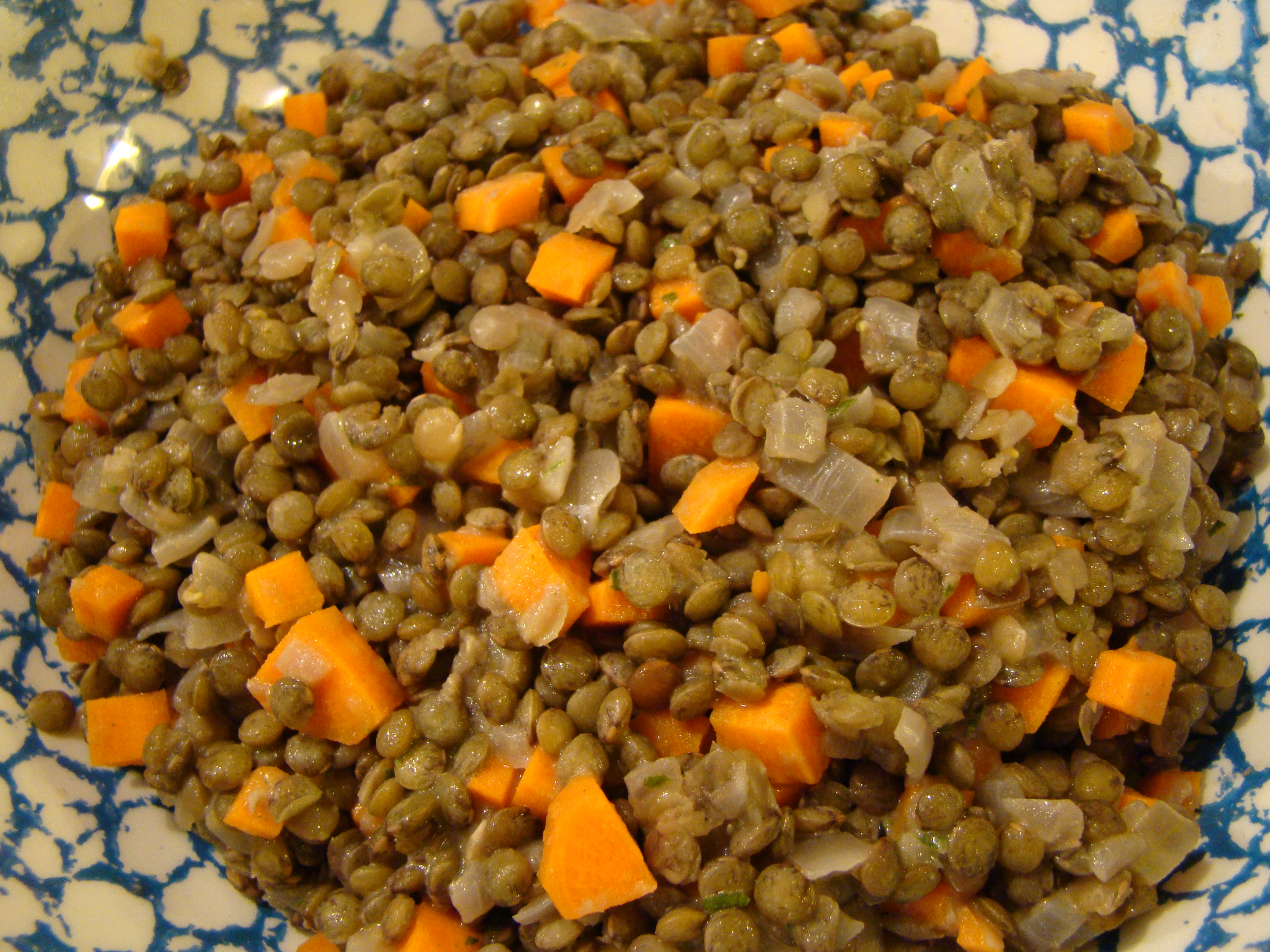
In addition to duck confit, I also love beans. My favorites, in no particular order, are tiny French lentils, black beans, and chick peas. Lentils are the perfect accompaniment to this French-inspired meal. I tossed cooked lentils with diced carrots and a vinaigrette heavily laced with tarragon for a warm salad that made a bed for the duck leg. Roasted asparagus rounded out the plate perfectly.
No leftovers, but we enjoyed every bite!
Lentil Salad
Serves 4 to 6 as a side dish
1 cup dried French (Le Puy) lentils, rinsed
1 onion, chopped fine
3 bay leaves
2 carrots, peeled, and diced fine
½ cup Tarragon Vinaigrette (recipe below)
Sort through the lentils and discard any rocks or other debris. Don’t skip this step. I always seem to find at least one little stone.
Place the lentils, onion, and bay leaves in a medium pot. Cover with water, about 1-inch above the contents of the pot. Bring to a boil, then reduce heat, cover, and simmer until tender, 20 to 30 minutes. Drain.
Toss the warm lentils with carrots and vinaigrette. Season to taste with salt and pepper.
I prefer this warm, but it’s good served at any temperature (warm, room temperature, or cold).
Tarragon Vinaigrette
Makes about 1 cup
When tarragon is booming in the herb garden, I make this dressing frequently. I also like to steep sprigs of tarragon in vinegar to make my own tarragon vinegar.
¼ c tarragon vinegar (or red wine vinegar)
2 Tbsp Dijon mustard
½ cup olive oil
2 Tbsp chopped tarragon leaves
½ cup chopped parsley (optional)
Salt & freshly ground pepper
In the blender, combine vinegar, mustard, and oil. Add herbs and blend until leaves are chopped fine, but not pureed. Season with salt and pepper to taste.
Leftover dressing is great on green salad and potato salad. When it sits, the vinaigrette sometimes thickens. Thin with water, as needed.
 A Plateful of Happiness