Monthly Archives: March 2010
Winter Wind Down

It’s so exciting! Winter is definitely on its way out! Next weekend, it will be officially be Spring. I’ve been noticing how much lighter it is when I leave work each evening. With the time change tonight, it will be light even later. I suppose that means it will get light later in the morning to compensate (and it will be really hard for me to get up in the morning).
Our bounty from the Winter CSA has dwindled, but we still have some vegetables left. They have stored well in plastic bags in the refrigerator. (We also have half a dozen butternut squash left in a basket in the basement.)
 I was able to put together a delicious shepherd’s pie with ingredients we had on hand: ground beef from Chestnut Farms, root vegetables from Shared Harvest CSA, and other odds and ends in the refrigerator, taking my herbal inspiration from Simon & Garfunkel (Parsley, Sage, Rosemary, & Thyme). I diced and roasted the vegetables the night before to make this easy to throw together after work, so it came together quickly.
Shepherd’s Pie
Serve 6
3 Tbsp olive oil, divided
2 parsnips, peeled and diced
4 carrots, peeled and diced
1 rutabaga, peeled and diced
1 celery root, peeled and diced
1 tsp sage, divided
1 tsp rosemary, divided
1 tsp thyme, divided
1 onion, diced
1 lb ground beef
1 Tbsp tomato paste
1 cup beef broth
½ cup chopped parsley
2 baking potatoes, peeled and cut into quarters
½ cup yogurt
Salt and pepper to taste
Preheat oven to 350F. Toss diced parsnips, carrots, rutabaga, and celery root with 2 Tbsp olive oil and ½ tsp each of the sage, rosemary, and thyme. Spread the vegetables in a single layer onto a large baking sheet. Bake for 30-40 minutes until the vegetables are tender and slightly caramelized.
Place the peeled potatoes into a pot of water. Bring to a boil. Cook until the potatoes are tender (about 15 minutes). Before draining, set aside ¼ cup of the potato cooking water. Drain the potatoes. Whisk the potato cooking water into the yogurt. Mash the potatoes with the yogurt mixture and a generous seasoning of salt.
In a large skillet, heat the remaining 1 Tbsp olive oil over medium high heat. Add onion and ground beef. Saute, breaking up the meat as it cooks, until the onions are soft and the meat is cooked through, about 5 minutes. If the meat gave off a large amount of fat, drain the fat before continuing.
Add tomato paste, beef broth, and the remaining sage, rosemary, and thyme to the meat. Cook until the sauce thickens up. Stir in the roasted vegetables and the parsley.
Pour the mixture into a 2-quart baking dish. Spread the mashed potatoes over the top of the meat.
Bake until edges of the mashed potatoes start to brown, about 25-30 minutes.
Guest Blog: Howard on Sous Vide
If you have been reading Betsy’s blog, you will notice that she enjoys cooking, a lot. Part of her joy in cooking is how she can relax while putting together an amazingly great meal in an hour or so and escape from her high tech software career with pots, pans and knifes. For me, the joy of cooking comes from the thrill of slow cooking food, such as the the slow BBQ of ribs or a brisket in a Texas smoker for 4 to 10 hours. But this is a warm weather activity, so during the colder seasons, I combine slow cooking with my many years of experience in the lab. (Ask Betsy how she enjoyed the trips to the lab to check on my experiments in the “warm room”).
There is a cooking technique called Sous Vide, French for “under vacuum”. I will explain the reason for the name later. The goal of Sous Vide is to cook food to a thermodynamically stable state in contrast to a specific kinetic time point. I’ll bet you didn’t expect to run across these terms in Betsy’s cooking blog. So much for her inviting me to be a guest blogger.
What does this all mean? Normally, food is cooked for a certain amount of time to reach a final desired temperature; say, for a rare steak, cooking it for 15 minutes over a 500F fire to reach an internal temperature of 125F , or, maybe, roasting a chicken for 1 hour in a 350F oven to reach an internal temperature of 180F. In these examples, cooking longer than the 15 minutes or 1 hour causes the food to overcook. This is what I mean by a specific kinetic time point. Get the time right, and the food is ready: too short of time and it’s undercooked; too long of time and it’s overcooked.
However, even when done correctly, the food actually has a temperature gradient from the outside to the inside. The outside of the steak is at 500F while the center is 125F. Cook a thick enough steak, and it becomes very hard to get the steak right without under- or overcooking the steak. The same is true with poultry or any other food. It’s just very difficult to get all the food to a single uniform temperature. Instead, consider setting the heat source to 125F or 180F. Cook the food long enough, and it will reach exactly 125F or 180F. It might take a while to cook, but no matter how long it’s cooking, the food can’t overcook. This is the thermodynamically stable state.
 Most ovens can’t cook at 125F or even 180F reliably. This is where my lab experience comes into play. In lab, we need to conduct experiments at a number of different temperatures. This is commonly achieved with water baths: metal tubs filled with water and heated with an electric coil controlled by an electronic thermostat. Some baths can be set as accurately as 0.1 F. So, knowing that every well-equiped kitchen needs its own accurate water bath, I bought an immersion circulating heater on eBay and rigged it to work placed in a pot of water. (N.B. The temperature display says 79.7 but that is Celsius, its about 180F.)
 Putting food into a water bath of this sort would cause most of the flavor to be washed out, sort of a low-temperature New England boiled dinner. This is where a seal-a-meal bag comes to the rescue. If the food is placed in a bag with spices and then sealed under vacuum (hence the origin of the cooking style “Sous Vide”) with the FoodSaver, the whole bag can then be placed into the pot, left until the food reaches steady state and then enjoyed at the finally desired temperature.
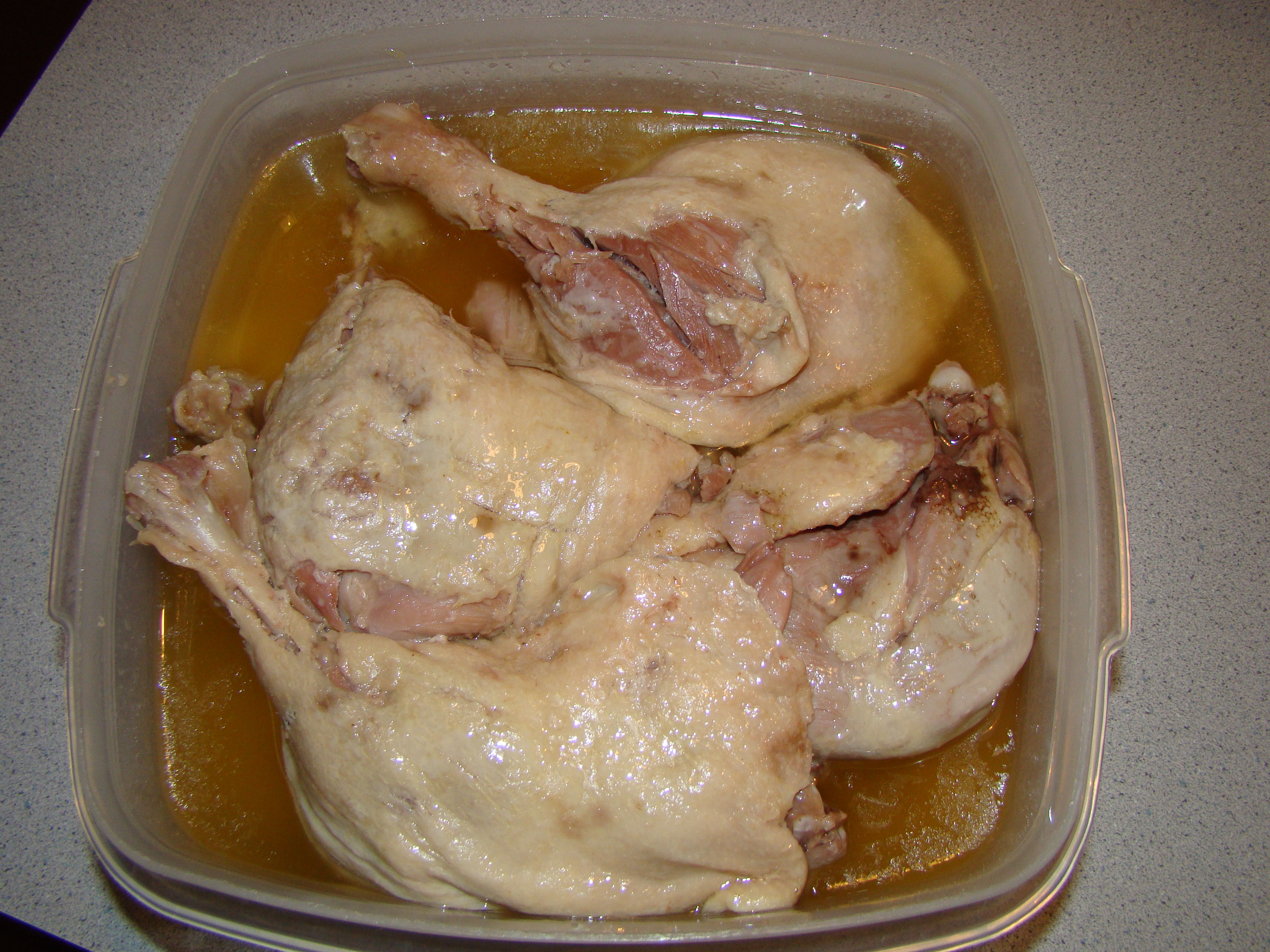
I have cooked a few different cuts of meat like this: Short Ribs, Fish, and Duck. This week, I made Duck leg confit. I have made this a number of times. Here’s how:
Duck Legs Confit, Part 1, the first 60 hours…
8 legs (1.95 Kg/4.31 lbs)
34 g salt (1.2 oz)
24 peppercorns
16 cloves
3 cloves garlic, sliced thinly
Coat the bottom of a glass baking dish with half the salt. Layer the legs in a single layer in the baking dish. Cover the legs with the remaining salt. Distribute the peppercorns, cloves and garlic slices over the legs.
Cover with plastic wrap and store in the refrigerator for 48 hours. (If you are in a rush, you can take them out after 36 hours.)
Rinse well and dry.
Place 4 legs into a seal-a-meal bag. Add 1 Tbs duck fat, and seal the bag. Repeat with the other 4 legs.
Place the bags into a 180F water bath.
Cook for 12 hrs (yes, twelve hours). Remove the bags from the bath and chill. Leave in refrigerator for a month or more. You don’t want to eat them right away.
I will be back then to discuss preparing the duck legs confit in Part 2.
 A Plateful of Happiness